An ill-structured problem is a complex discrete or continuous problem whose scope, state, or environment is dynamic, uncertain, partially observable, or difficult to specify completely. It lacks an exact mathematical model, a proven algorithmic solution, or a general-purpose solver. section 1.4.2 section 1.6
Common characteristics include:
- Different interpretations of the problem, unclear goals, multiple modes, and a changing problem space. section 1.4.2
- Contradictory solutions, unpredictable consequences, difficult risk calculation, and unclear evaluation criteria. section 1.4.2
- Imperfect data caused by uncertainty, partial observability, vagueness, incomplete information, ambiguity, or unpredictability. section 1.4.2
- Large or computationally intractable search spaces that classic optimization methods cannot efficiently handle. section 1.4.2 section 1.6
Elevator dispatching
Assigning four elevators across ten floors illustrates the challenge. User calls and destinations are unpredictable, new requests can change the best decision immediately, and roughly 10^21 possible states arise from elevator positions and button states. Objectives may conflict: minimize waiting time, minimize total system time, limit waits over 60 seconds, and preserve fairness. section 1.4.2
Figure 1.9 Elevator dispatching problem—with four elevator cars and 10 floors, this problem has ~1021 possible states.
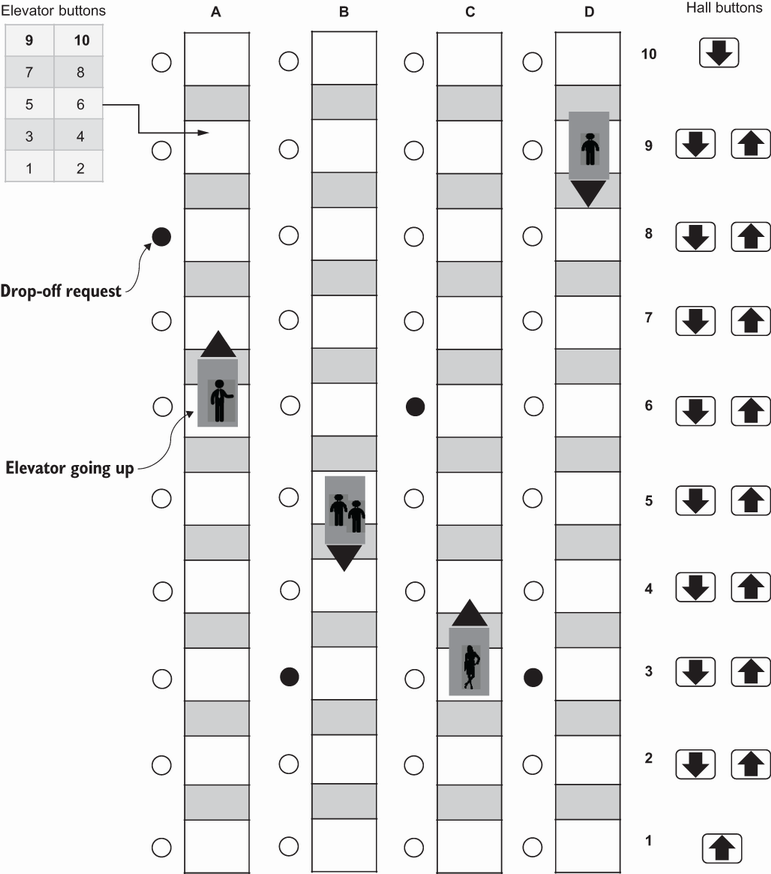
Use the elevator-state figure to visualize why dynamic decisions and many possible states make exact optimization difficult. section 1.4.2
Practical solutions often seek a good or near-optimal answer quickly rather than an exact optimum. Derivative-free stochastic algorithms suit these settings because randomized states and operators can escape local optima; their central challenge is balancing exploration with exploitation. section 1.4.3 section 1.6