Imitation intelligence is the appearance of intelligence produced by behavior that resembles intelligent performance. Convincing behavior alone does not establish genuine understanding: observers may see intention or thought where there is only a process producing familiar patterns. At the same time, performance can be genuinely useful even when its mechanism differs from human thinking. section 1.2.2 section 9.1.1
One distinction is between brittle and adaptive imitation. Brittle imitation works under narrow conditions but fails when those conditions change. Adaptive imitation continues to perform in unfamiliar situations, making the line between imitation and ability harder to draw. section 9.1.1
From a chatbot to a chess engine
ELIZA, a 1960s chatbot, simulated a psychotherapist through pattern matching but could fail when conversation moved beyond its built-in patterns. A chess engine, by contrast, responds to the board and can succeed in positions it has never encountered, even though it does not play as a human does. section 9.1.1
Figure 9.1 Brittle and adaptive imitation. A brittle system may appear capable when tested on familiar cases, but its performance collapses when the situation changes. In chess, this would be a system that plays well only in familiar positions. An adaptive system continues to perform in unfamiliar cases, making the difference between imitation and ability harder to draw.
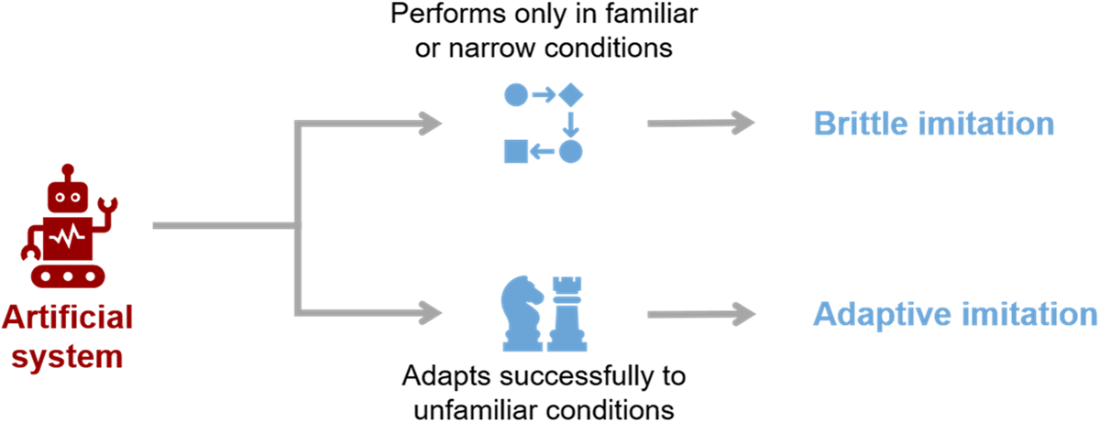
The figure contrasts performance on familiar and unfamiliar cases, illustrating why adaptive imitation is harder to distinguish from ability. section 9.1.1
Large language models adapt across topics, formats, styles, and tasks, but can still hallucinate or break rules. Their flexible performance makes a simple dismissal as brittle imitation inadequate; it does not by itself settle whether they understand. Because human thought is also inferred from outward signs, the distinction becomes a question about how understanding can be recognized, not just how behavior is produced. section 9.1.1 section 1.6.2 section 1.5.5
A measured judgment separates demonstrated capabilities from claims about a human-like mind. Current systems can reason, adapt, and solve problems, yet their abilities are uneven and depend on training data, prompts, tools, and surrounding systems. They also lack features associated with human cognition, such as an embodied perspective and a continuous lived history. section 9.5.6
