Recommender systems use implicit learning to infer preferences from how people interact with items, rather than asking them to evaluate every recommendation. The approach assumes that observed behavior can reveal preferences that may not be directly measurable. section 4.2
That inference has limits. Engagement metrics serve as proxies for recommendation value, and assuming people have a fixed set of preferences can be reductive. Systems also balance familiar recommendations against discovering new interests; too much novelty may annoy users, while too little may miss what they value. section 4.2
A preference the system misses
A user loves books, but the recommender does not recognize that interest and keeps reinforcing preferences it already knows. section 4.2
Figure 4.1 Recommender systems learn our preferences by observing our interactions with the items they present. There is no guarantee that all the preferences will be appropriately accounted for. In this figure, the user is a book lover, but the system is unaware of their preferences, and it’s reinforcing the known ones.
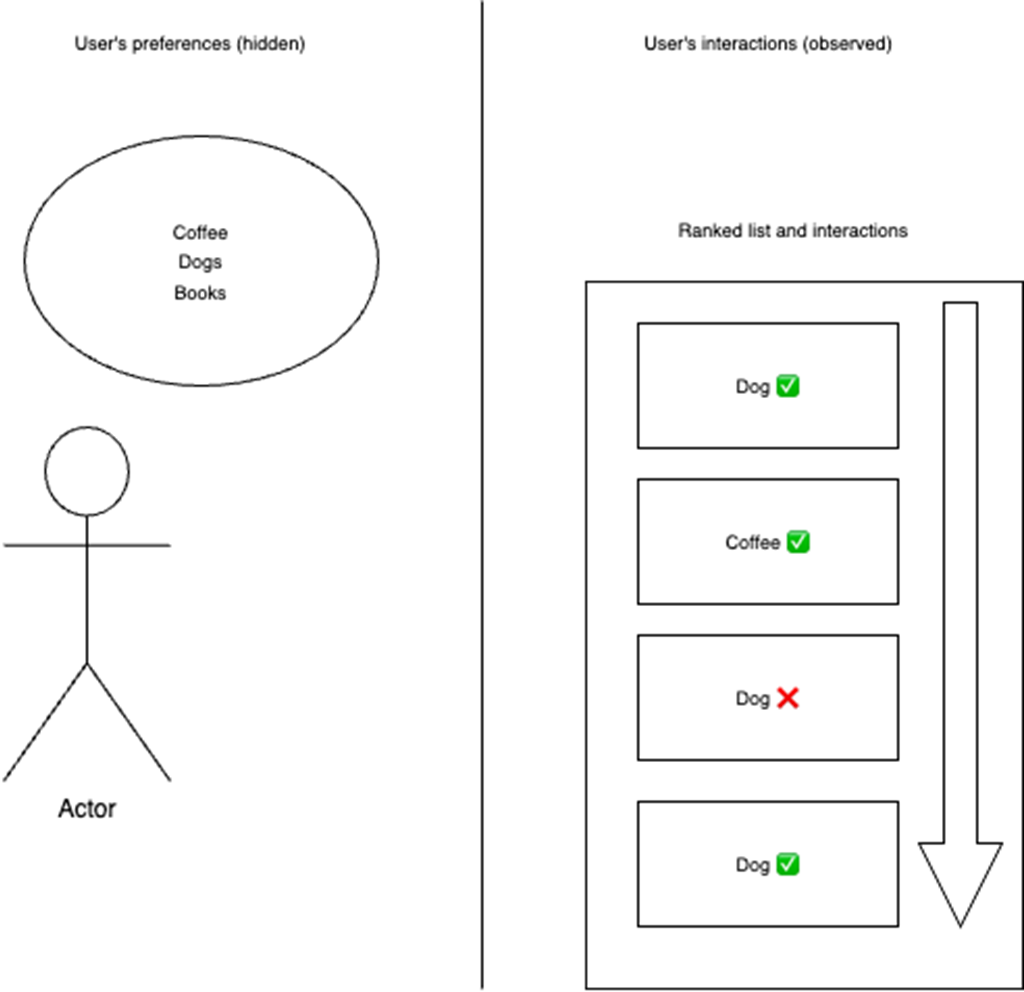
The figure illustrates how observed interactions can reinforce known preferences while leaving others unaccounted for. section 4.2
