An implicit relationship is a connection inferred from a graph pattern rather than stored as a direct edge. For example, two categories may overlap because the same lesson belongs to both, even though no category-to-category relationship exists. Making that overlap visible can reveal correlations and prompt investigation of the underlying records. section 1.0
A transitive relationship is a simple indirect case: A connects to B, and B connects to C, so A and C are connected through B without a direct link. Such paths matter when evaluating influence, similarity, or other network patterns that depend on more than immediate neighbors. section 2.3.1
Implicit relationships are commonly used to:
- Identify similar customers from shared purchases in a bipartite User–Item graph, supporting customer segments and collaborative-filtering recommendations. section 1.2.3
- Infer article similarity or topic correlation from shared graph structure, improving search or recommendations. section 1.2.3
- Turn an indirect pattern into a direct relationship when an analysis or algorithm needs a simpler network shape. section 2.4.4 section 6.0
Modeling retweet amplification
A retweet pattern connects two users through tweets: one user publishes a tweet, another retweets it, and that second user publishes the retweet. To analyze influence among users, infer a direct AMPLIFY relationship between the users. In Cypher, match the stored pattern and create the projected edge: MATCH (s:User)-[:PUBLISH]->()-[:RETWEETS]->()<-[:PUBLISH]-(t:User) CREATE (s)-[:AMPLIFY]->(t); The resulting monopartite graph contains User nodes and AMPLIFY relationships, allowing PageRank to evaluate influence through retweet behavior. section 6.0
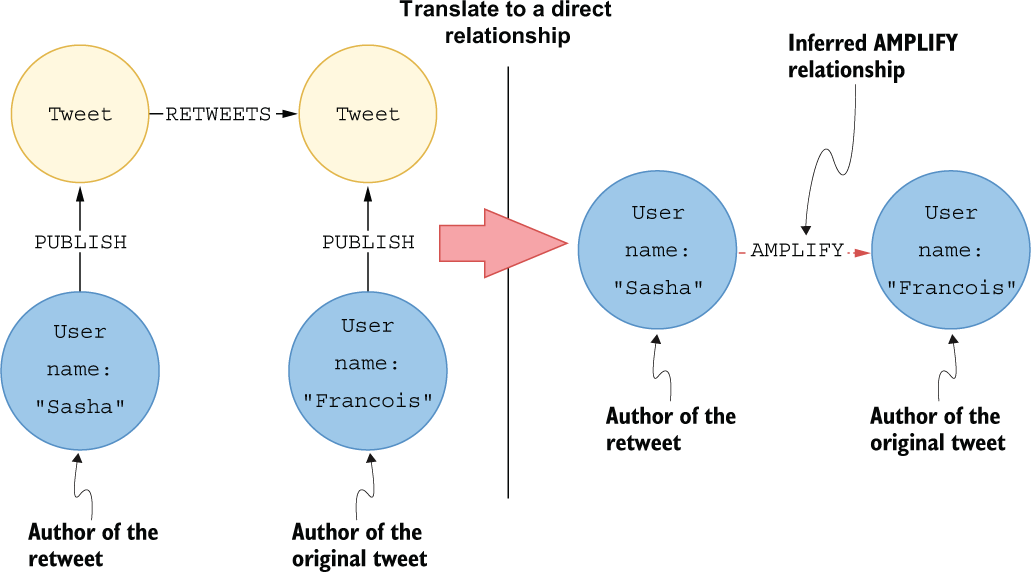
Compare the stored multi-edge retweet pattern with the inferred direct AMPLIFY edge used to represent influence flow between users. section 6.0
