Suppose a demand forecast uses promotions, past sales, and weather. An importance score helps answer which inputs contribute to its prediction or performance. That answer can guide feature selection, make a prediction easier to explain, and help decide whether a newly trained model is ready to deploy. A low-scoring feature may be a candidate for removal, but the decision should also consider the feature’s cost and the model’s overall performance. section 11.5.1 section 11.2 section 11.1.1
Choose an importance method that fits the model and the question:
- For some classical models, inspect coefficients or decision rules. An embedded feature selector can use those scores: recursive feature elimination repeatedly removes the lowest-ranked features. section 11.2.1 section 11.3.3
- To examine a model without relying only on its internal structure, alter or shuffle an input and observe the effect. SHAP, LIME, and shuffle importance are options for comparing contributions. section 11.2.1 section 11.5.1
- For images or text, first decide what counts as a feature: a pixel, token, or higher-level pattern. SHAP can attribute outcomes to tokens or pixels; a saliency map highlights image regions whose changes affect an output. These methods do not provide a universal explanation of deep learning. section 11.2.3 section 11.2.1
Use scores to make a feature decision
For a store-and-product demand model, candidate inputs include a promotion calendar, recent sales, and predicted weather. Measure their contributions with methods such as SHAP, LIME, shuffle importance, model coefficients, or gradient-boosting split counts. Drop a feature that contributes little; during early exploration, recursive feature elimination can help establish a basic set. Keep range, correlation, contribution, and computation-time tests in the training pipeline rather than treating an importance score as the only check. section 11.5.1
Scores can serve two different decisions. An overall view can show where to invest in feature engineering. An explanation for one prediction can help investigate a complaint—for example, why a search result ranked as it did. If a model relies heavily on one source of information, examine whether that reliance creates overfitting or opportunities to exploit its weaknesses. Importance is evidence for investigation, not a substitute for checking the system’s behavior. section 11.5.2 section 11.1.1
Figure 11.2 An example of a taxi aggregator app’s UI that clarifies why its dynamic pricing algorithm chooses this particular price in this area and during this time of the day
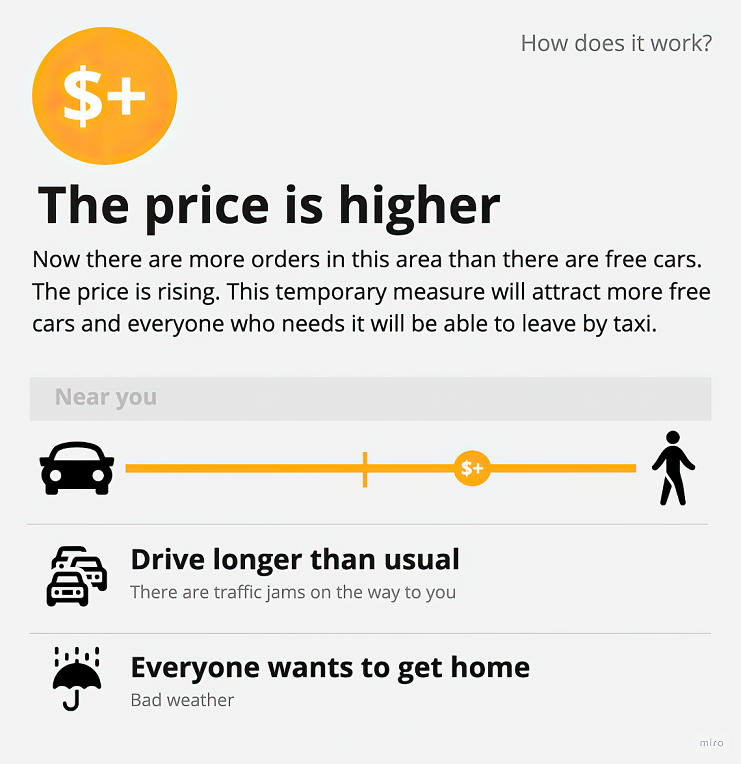
The taxi-pricing interface illustrates the user-facing purpose of an explanation: connecting a particular price to conditions affecting that ride. section 11.2





