Incremental revenue is the additional revenue generated by an intervention group compared with a control group. It turns campaign performance into financial evidence by showing the revenue lift attributable to the intervention rather than to coincidence or outside factors. section 7.7.3 section 1.6.1
Use incremental revenue to:
- Compare treatment and control groups to identify the revenue effect of a campaign or personalized experience. section 7.7.3
- Judge whether segmentation, personalization, or an added channel produces enough financial uplift to justify its effort. section 7.7.3
- Pair revenue lift with incremental conversion rate and customer lifetime value uplift for a broader view of campaign impact. section 7.7.3
Testing an added SMS sequence
An experiment gives the treatment group an SMS sequence alongside email, while the control group receives only email. Higher revenue from the treatment group represents the incremental effect of SMS. A personalized landing page tested against a generic page applies the same logic to personalization. section 7.7.3 section 7.7.3
Figure 1.4 Funnel stages of first-party data-driven marketing
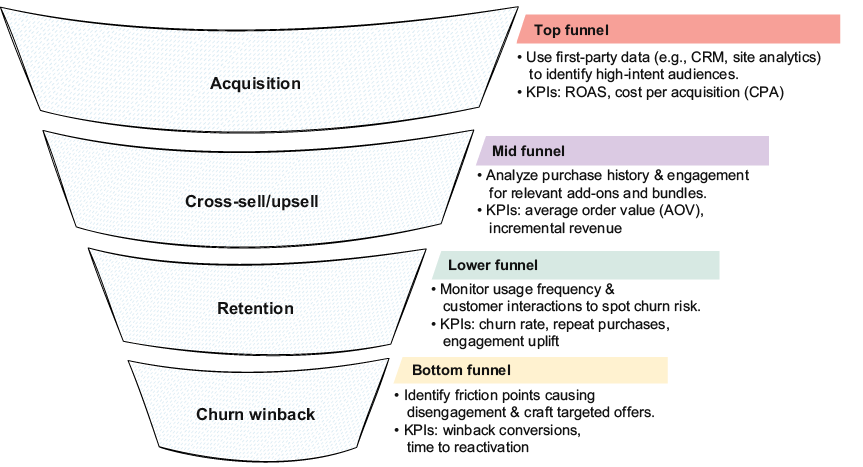
Locate incremental revenue among the acquisition, cross-sell, upsell, retention, and churn-winback stages where it serves as a marketing KPI. section 1.6.1
