Incubation is the creative interval in which conscious problem-solving gives way to less direct mental work. It does not mean waiting passively for inspiration: useful incubation follows participation, preparation, and sustained attention. section 7.4
For programmers, incubation resembles the pauses within test-driven development: investigate the problem, work with its constraints, then allow connections to form before returning to the solution. Curiosity, a supportive creative state, and contact with other people can increase cross-pollination. section 5.2
Use incubation as a flexible rhythm rather than a rigid formula:
- Prepare deliberately by gathering data, exploring the problem, and understanding relevant constraints. section 5.2
- Alternate periods of focused work with time away from the immediate puzzle; insight may emerge after clues have had time to connect. section 7.4
- Treat illumination as a beginning, not proof: verify the idea, present it, and rework it if necessary. section 5.2
The detective’s sudden realization
A crime-show inspector appears to solve everything in one flash, but the insight rests on earlier perspiration: collecting clues, connecting them, and noticing when they fit the larger picture. A programmer’s breakthrough often works the same way. section 7.4
Figure 5.2 The five steps of the creative process. An overabundance of arrows emphasizes the interrelatedness among the steps. Participation is usually step 1, but a sudden idea might just as well put the process in motion. Rejection is not necessarily the end, provided enough energy remains to rework the concept.
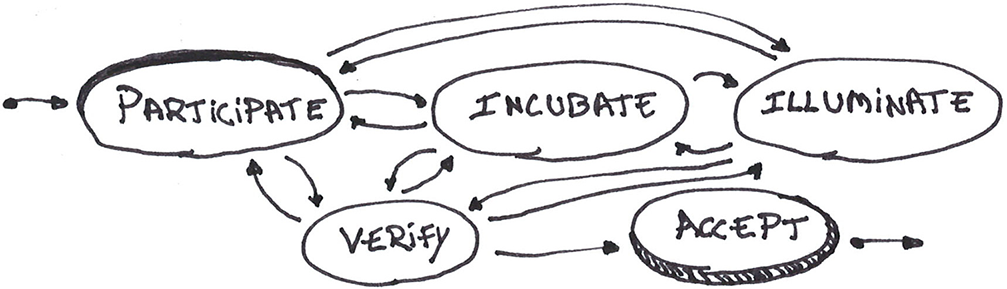
The process diagram emphasizes that incubation is connected to the other stages rather than locked into a one-way sequence; rejection can lead back into reworking. section 5.2

