IND-enabling studies are preclinical investigations that support an investigational new drug application and first-in-human testing. They connect an optimized lead to clinical-candidate readiness through experimental safety, pharmacology, and efficacy evidence. section 13.3.1
A practical package can include:
- Confirming potency and cellular activity across multiple assay formats. section 13.3.1
- Profiling selectivity experimentally against broad target panels rather than relying only on computational predictions. section 13.3.1
- Comparing predicted and measured solubility, permeability, and metabolic stability. section 13.3.1
- Testing dose-dependent efficacy in an animal disease model. section 13.3.1
Rentosertib program
INS018_055 completed standard IND-enabling studies in nine months. Experimental work confirmed TNIK potency, cellular antifibrotic effects, adequate ADMET properties, and dose-dependent efficacy in pulmonary fibrosis, while revealing off-target kinases missed computationally. section 13.3.1
Figure 13.7 The four stages of the rentosertib program. Multi-omics data and literature flow through PandaOmics to a scored target list; Chemistry42 generates and optimizes candidates against a multi-objective reward; experimental readouts feed back to refine the models; clinical development follows. Sections 13.3.1 through 13.3.4 walk through each stage.
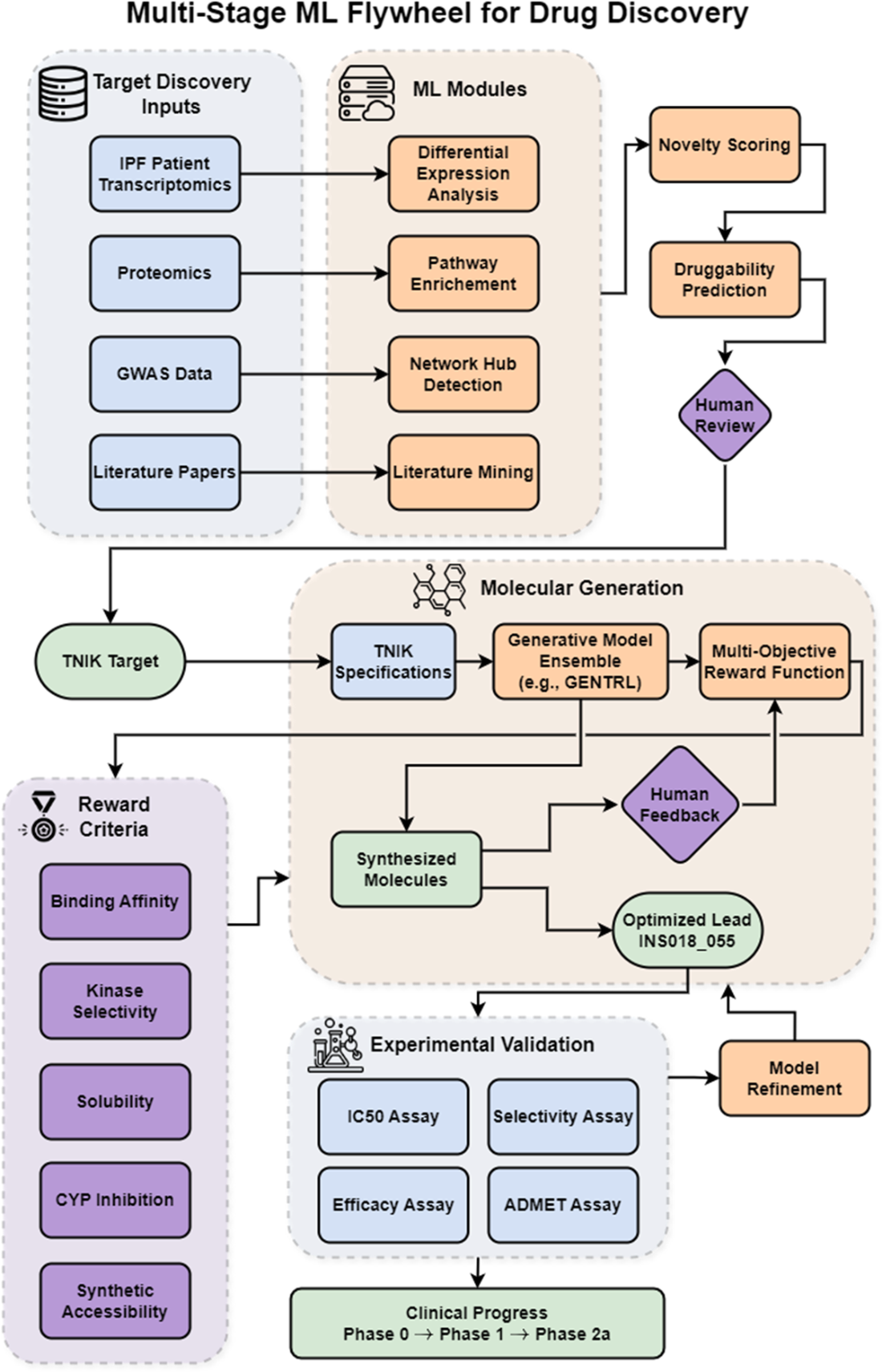
Use the four-stage program figure to place IND-enabling studies within the transition from AI-assisted discovery and lead optimization to clinical development. section 13.3.1
