Index reorganization is a lower-cost maintenance operation that condenses leaf-level pages toward FILLFACTOR and rearranges them without creating a replacement B-tree. It can address internal and external fragmentation, but it cannot lower already-full pages to the configured FILLFACTOR. section 11.3
Mistake: reorganizing a low-FILLFACTOR index
Suppose an index intentionally uses a 60% FILLFACTOR. Reorganizing it after observing low external fragmentation leaves pages full rather than restoring 60% density. Inserts can then cause page splits and quickly recreate external fragmentation, forcing a rebuild soon afterward. section 11.3
Use these rules when choosing index maintenance:
- Measure both avg_fragmentation_in_percent and avg_page_space_used_in_percent with sys.dm_db_index_physical_stats; focus on leaf-level data rather than aggregated fragmentation. section 11.3
- Choose a rebuild when page density must be reduced or fragmentation requires more complete repair; do not rebuild every index indiscriminately. section 11.12 section 11.3
- Interpret fragmentation operationally: external fragmentation harms scans, while seeks are not impacted. section 11.12
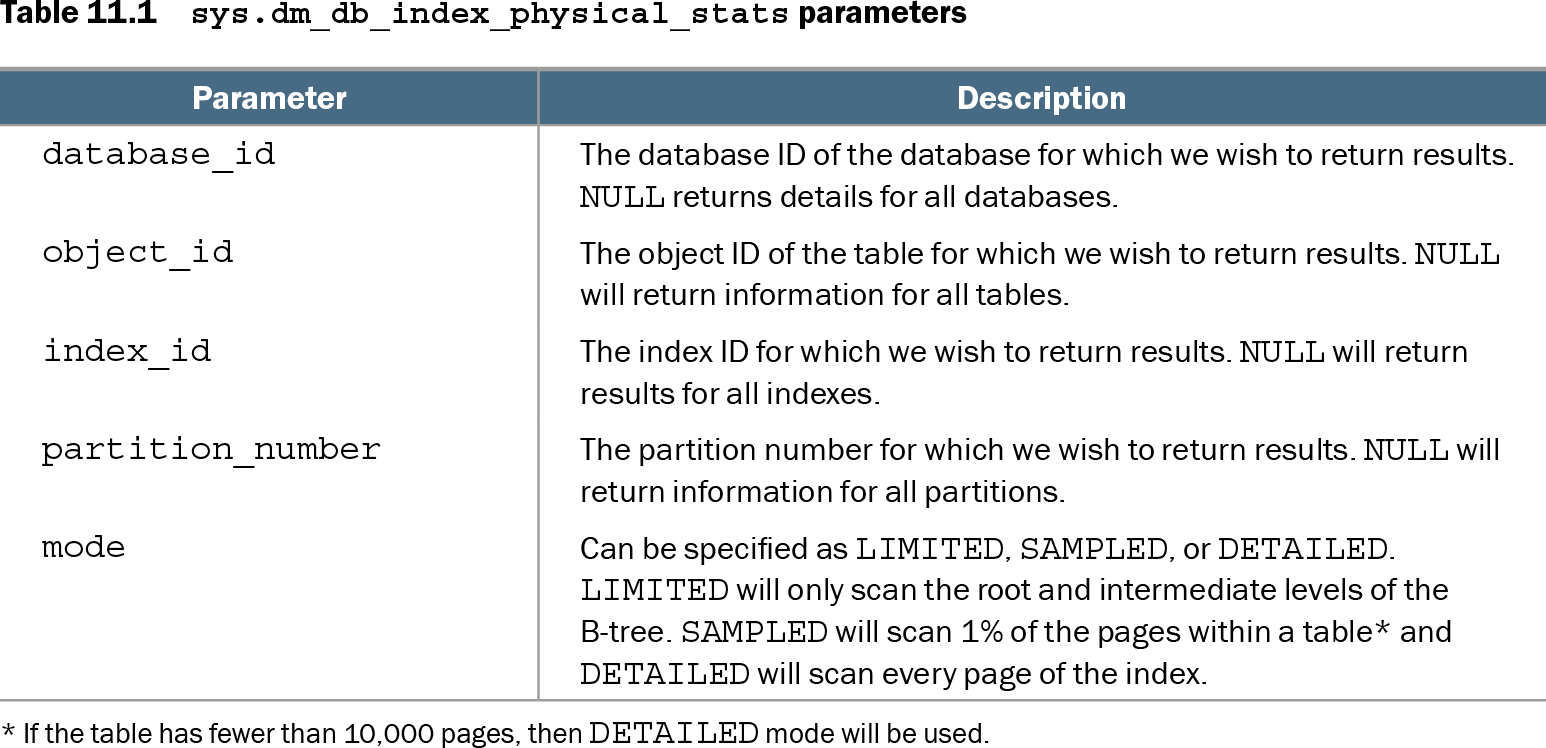
Table 11.1 sys.dm_db_index_physical_stats parameters (view table figure)
| Parameter |
Description |
|---|---|
| database_id |
The database ID of the database for which we wish to return results. NULL returns details for all databases. |
| object_id |
The object ID of the table for which we wish to return results. NULL will return information for all tables. |
| index_id |
The index ID for which we wish to return results. NULL will return results for all indexes. |
| partition_number |
The partition number for which we wish to return results. NULL will return information for all partitions. |
| mode |
Can be specified as LIMITED, SAMPLED, or DETAILED. LIMITED will only scan the root and intermediate levels of the B-tree. SAMPLED will scan 1% of the pages within a table* and DETAILED will scan every page of the index. |
| * If the table has fewer than 10,000 pages, then |
|
Inspect the physical-stats parameters to choose database, object, index, partition, and scan scope before diagnosing fragmentation. section 11.3