Inductive bias is the set of assumptions built into an algorithm or model architecture that makes some patterns or hypotheses more likely than others. Treat it as a design decision: choose components whose assumptions fit the available data, required output, production environment, transparency needs, latency, cost, and energy constraints. section 7.3 section 7.3.3
Turn inductive bias into an explicit model-design ticket:
- List the patterns the data is likely to contain and the assumptions each candidate component makes. section 7.3
- Compare alternative representations and splitting or learning criteria, including their effects on transparency, performance, training cost, latency, and operational impact. section 7.3.3 section 7.3.4
- Record the chosen bias, the evidence supporting it, and the conditions under which the model should be rejected or redesigned. section 7.6
Smart-building sensor failures
For sensors described by age, manufacturer, installation location, and failure status, a decision tree might split first on internal versus external installation because failure rates differ. An alternative age > 100 days split can create a pure failed-sensor branch. The choice of split criterion therefore favors particular regularities, while simpler trees may be preferred under an Occam’s razor heuristic. section 7.3.4
Figure 7.4 Splitting the training data using the installation attribute. Outside sensors (right) fail much more often than inside ones.
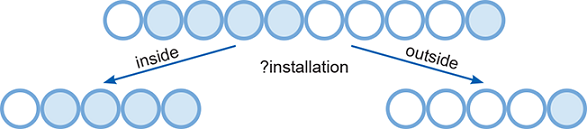
Use the training-data split figure to inspect how an installation-based decision changes the distribution of failed and non-failed sensors. section 7.3.4


