liveBook · Manning

Inductive embedding

As explained in Optimization Algorithms: AI techniques for design, planning, and control problems

Inductive embedding is a graph embedding technique that learns a general representation-generating function applicable to unseen entities or graphs.

Inductive embedding learns a function that generates representations for nodes or entire graphs, including entities absent from training. It uses node features and local-neighborhood structure, making it useful for evolving graphs. section 11.3.1

The key distinction is whether representations generalize beyond the training graph:

  • Transductive embedding learns representations only for training nodes, so it suits static graphs but cannot directly represent new nodes. section 11.3.1
  • Inductive embedding learns a reusable representation-generating function, with graph neural networks and graph convolutional networks as examples. section 11.3.1

Node embedding with a GCN

A practical implementation uses PyTorch Geometric and the Cora dataset. A two-layer GCN applies graph convolutions, ReLU activation, and dropout; Adam trains it for 200 epochs using the training-node mask. section 11.3.1

Figure 11.8 Node embedding using GCN in PyG
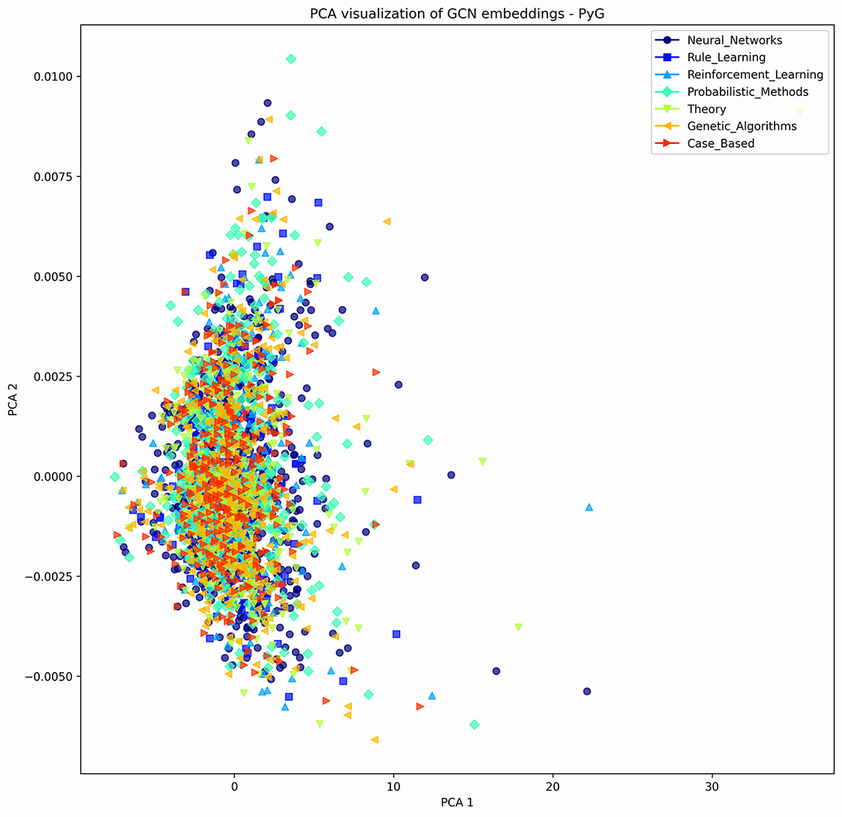
Inspect the PyTorch Geometric visualization of node embedding with a GCN. section 11.3.1

How Optimization Algorithms: AI techniques for design, planning, and control problems covers it

How deep it goes
Explains feature-and-neighborhood encoding and contrasts it with transductive methods, then demonstrates a GCN implementation.
Examples
Uses Cora, PyTorch Geometric, a two-layer GCN, dropout, Adam optimization, and masked node training.
What you can do after
Builds a GCN-based embedding model that represents graph nodes using features and neighborhood structure.
How it connects
Connects graph embedding with transductive learning, graph neural networks, graph convolutional networks, and node classification.

Related concepts

This explainer was generated by Manning's knowledge graph from the text of Optimization Algorithms: AI techniques for design, planning, and control problems. The section links point to the parts of the book it draws on.