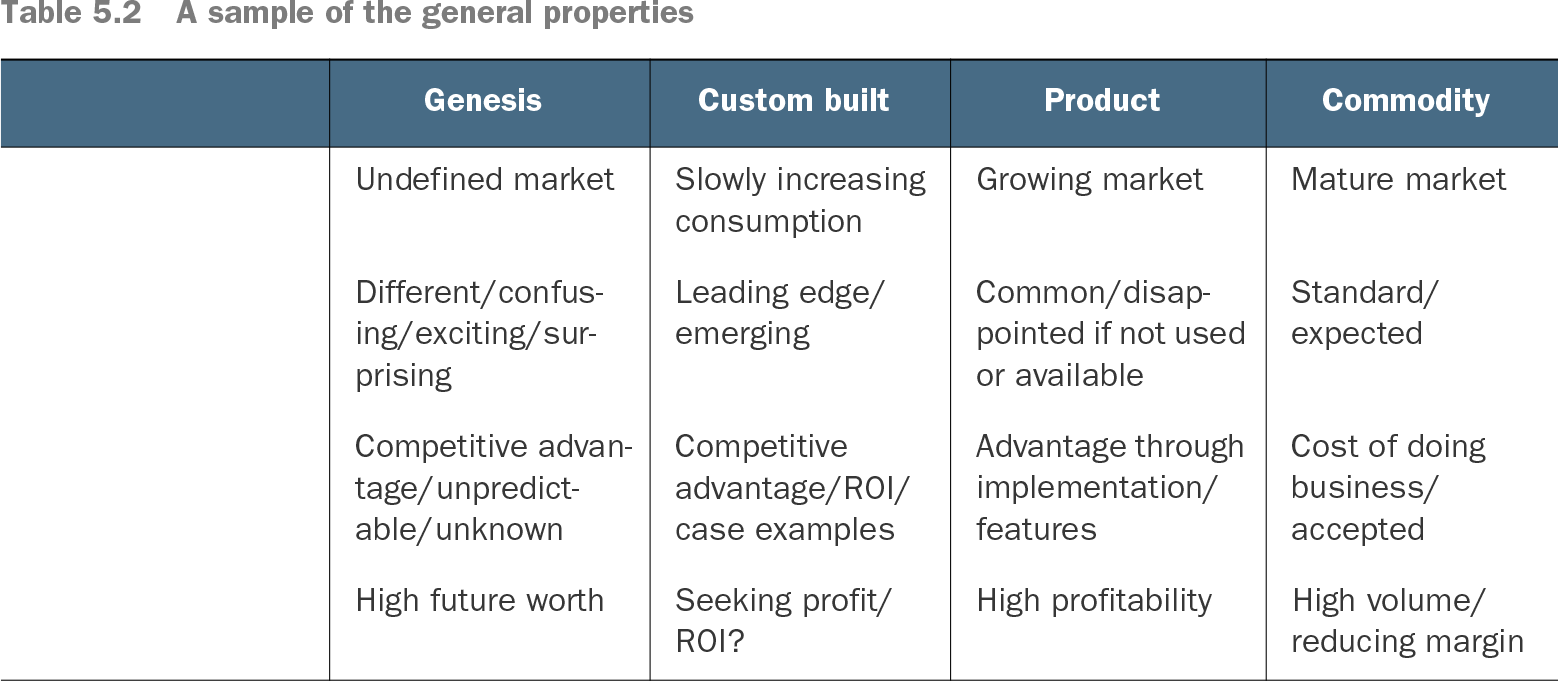
Industry perception describes how an industry views a capability’s strategic significance, usefulness, and potential for competitive advantage. It helps distinguish capabilities worth strategic attention from table-stakes functions that should simply operate efficiently. section 5.3.1
Use industry perception alongside evolutionary stage to interpret what a capability means competitively:
- Genesis capabilities may represent unpredictable or unknown competitive advantage. section 5.3.1
- Custom-built capabilities invite competitive advantage assessments through return on investment and concrete case examples. section 5.3.1
- Product capabilities provide advantage through implementation or features. section 5.3.1
- Commodity capabilities become an accepted cost of doing business rather than a strategic differentiator. section 5.3.1
Restaurant menus and optimization
Administering and browsing a restaurant menu is generally a commodity: it is a table-stakes capability with limited strategic importance. Restaurant optimization can offer competitive advantage by improving restaurant profitability and attracting partners, even when its immediate financial return is negative. If unique recipes create differentiation, model menu R&D separately from routine menu administration. section 5.3.1
Table 5.2 A sample of the general properties (view table figure)
Compare industry perception with market condition, user perception, and focus of value across genesis, custom-built, product, and commodity stages. section 5.3.1