An inequality constraint limits admissible values by requiring a result y to lie within a numerical range, such as a ≤ y ≤ b. In optimization, it defines which candidate points are feasible. The best unconstrained point may violate the constraint, so the goal becomes finding the highest-valued feasible point. section 8.1 section 8.1.1
Inequality constraints matter because they:
- Exclude solutions that are unsafe, too expensive, computationally impractical, or otherwise unusable. section 8.1.1
- Can change the optimal solution rather than merely reduce the value achieved at the unconstrained optimum. section 8.1.1
- Require optimization and constraint satisfaction to be pursued together. section 8.1.1
A one-dimensional cost constraint
Suppose an objective is maximized over x, but a cost function must remain nonpositive. The unconstrained optimum at x = 4.6 is infeasible because its cost is positive. Enforcing the inequality changes the optimum to x = 1.6; in another example, ruling out x > 3 selects a different local optimum. section 8.1.1
In constrained Bayesian optimization, a separate Gaussian process models the objective or a constraint-defining function. Constrained expected improvement multiplies ordinary expected improvement by the probability that a candidate satisfies the inequality, favoring points that are both promising and likely feasible. section 8.2
Figure 8.4 Formula for the acquisition score of constrained EI, which is the product of the regular EI score and the probability of feasibility. This policy aims to optimize the objective value and satisfy the constraints at the same time.
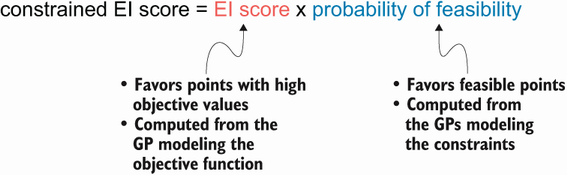
The acquisition-score formula shows how expected improvement and probability of feasibility jointly guide constrained Bayesian optimization. section 8.2
