An infeasible point is a data point that violates at least one predefined constraint, so it cannot serve as the solution to a constrained optimization problem. Optimization instead seeks the highest objective value among feasible points. section 8.1.1 section 8.6
A constrained one-dimensional search
Suppose the objective is the Forrester function and the cost constraint is c ≤ 0. The region x > 4 contains the unconstrained global optimum, but violates the cost constraint; the constrained optimum therefore occurs elsewhere and reaches only about 4 instead of more than 8. section 8.1.1
Figure 8.1 An example of a one-dimensional constrained optimization problem. The solid line is the objective function we aim to maximize, and the dashed line is the cost function that constrains the optimization problem. Only the shaded regions (right panel) that yield negative costs are feasible. Here, the constraint of nonpositive cost causes the highest objective value to decrease from more than 8 to 4.
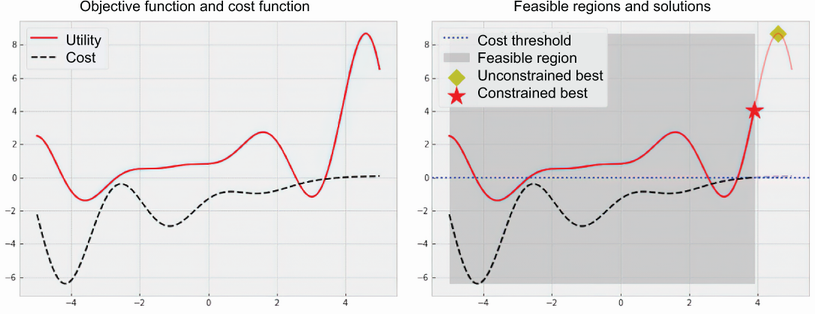
Compare the objective and cost curves with the shaded feasible regions to see how a constraint removes high-value candidates. section 8.1.1
Infeasibility changes optimization in two important ways:
- Excludes regions that may contain high objective values, potentially changing the optimal solution. section 8.1.1
- Supports constrained Bayesian optimization, where constraint models estimate feasibility and modify acquisition scores. section 8.6
