Model serving hosts a trained machine learning model, accepts input data, executes the model, and returns predictions. A common form is a prediction service: a web service exposing a model’s predict function through an API, while hiding model loading and framework-specific execution from callers. section 6.1.3 section 6.1.5
A typical request path receives a prediction request, loads the required model from an artifact store into memory or GPU, runs its algorithm, and returns a result. Serving may support online, low-latency requests or offline batch inference; requirements determine network placement, model count, hardware, memory, and supporting preprocessing components. section 1.2.2 section 6.1.3
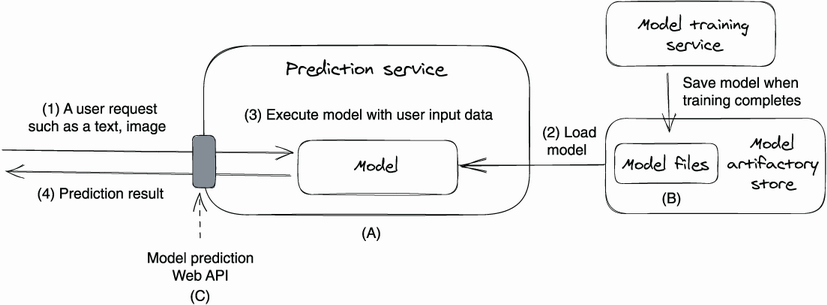
Follow the basic relationship among the prediction API, prediction service, and model artifact store. section 6.1.3
Choose an architecture from the user scenario rather than aiming for one universal service:
- Use direct model embedding when prediction runs locally inside an application. section 6.2
- Use a model service for one model, version, or model type. Package execution logic in a container, expose HTTP or gRPC, and scale instances behind a load balancer. This is simple, but separate models create separate services to patch, deploy, and monitor. section 6.2.2
- Use a model service with an in-memory model cache for multitenant workloads whose tenant models share an algorithm and prediction function. section 6.3.2
- Use a centralized model server or prediction platform when multiple applications need different model types. It consolidates onboarding and maintenance but requires unified APIs, routing, versioning, caching, execution support, and model management. section 6.3.3 section 6.4
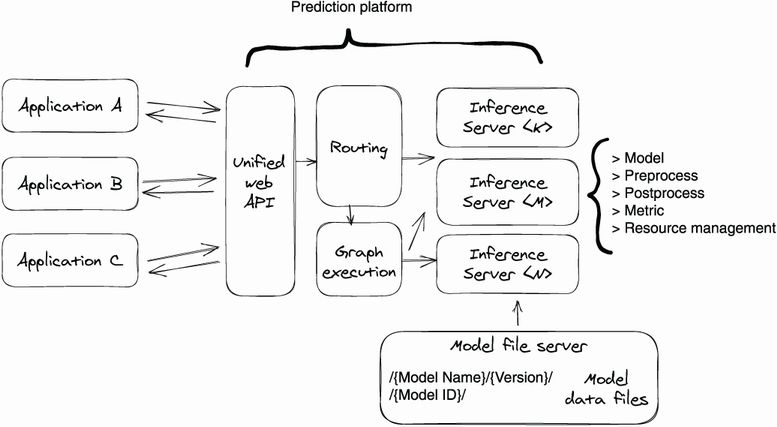
Inspect the components needed when one platform must route and execute arbitrary model types. section 6.3.3
Tenant-specific chatbot predictions
A multitenant chatbot can select an intent-classification model for each tenant. Because the models use the same algorithm, one prediction service can keep model graphs and dependent data in a cache, loading model files as needed. section 6.3.2
Production serving must balance latency with resource saturation and accommodate differing input and output formats, frameworks, model sizes, and hardware needs. Treat deployment safety, rollback, monitoring, and alerting as core requirements: outages or rising latency immediately affect applications that depend on real-time predictions. section 6.1.4 section 6.3.4




