Information gain measures how much a candidate split reduces uncertainty about class labels. In a classification tree, the algorithm searches feature values for splits that leave more homogeneous target groups; the split with the strongest improvement is preferred. section 5.1
It is one of several ways to judge classification splits. Entropy describes label disorder, information gain expresses the uncertainty reduction produced by a split, and Gini impurity estimates random-label misclassification risk. Regression trees instead seek splits that reduce target error or variation, such as mean squared error, mean absolute error, or variance. section 5.1
Information gain guides tree construction in several ways:
- Search candidate features and observed values, then select the feature-value combination producing the most homogeneous class subsets. section 5.1
- Prioritize the leaf with maximum loss reduction in LightGBM’s leaf-wise growth, rather than splitting every node at one depth. section 5.5.1
- Evaluate candidate thresholds efficiently with presorting or histograms when finding XGBoost splits. section 5.4.3
Choosing a tree-growing strategy
With a limit on depth or terminal leaves, leaf-wise growth repeatedly expands the leaf with the greatest information gain first. This can yield smaller trees, faster training, and higher accuracy than level-wise growth, though the approaches differ chiefly because the stopping rule interrupts their construction paths. section 5.5.1
Figure 5.10 How level-wise (on the left) and leaf-wise (on the right) tree growth differ
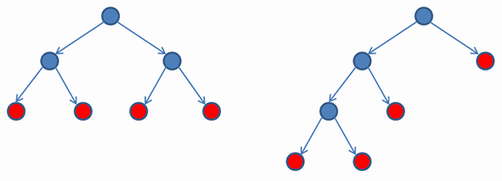
Compare level-wise and leaf-wise growth paths to see why selecting the maximum-gain leaf changes which splits appear before a tree reaches its size limit. section 5.5.1
Accelerating threshold search
For each node, XGBoost can enumerate features, inspect values, compute information gain for candidate splits, and retain the best result. Histogram-based candidates reduce the number of split points examined and can be evaluated in parallel; the illustrated latitude split produces the same threshold with a much shorter reported runtime when using 256 bins. section 5.4.3 section 5.4.3



