Information loss is the loss of meaningful content or distinctions when variables are removed, data is compressed, or high-dimensional data is transformed. Dimensionality reduction should simplify computation without discarding distinctions needed to represent the original data or support accurate predictions. section 3.3 section 3.7
Assess information loss by checking what the reduced representation preserves:
- Retain variables or components that capture information relevant to the prediction task; irrelevant variables can be removed without reducing capability. section 3.3
- Treat PCA and SVD components as approximations rather than replacements for the original dataset, because compression can discard information. section 3.7
- Expect the trade-off to include simpler computation and reduced overfitting, but potentially lower interpretability and predictive accuracy. section 3.3 section 3.11
Rainfall prediction
Temperature, wind speed, pressure, distance from the sea, and elevation can affect rainfall prediction. Cinema halls, capital-city status, and red-car counts are unlikely to help; removing them should not cause meaningful information loss. Removing temperature or distance from the ocean could reduce prediction accuracy. section 3.3
Figure 9.1 Structure of an autoencoder with an encoder, a bottleneck, and a decoder
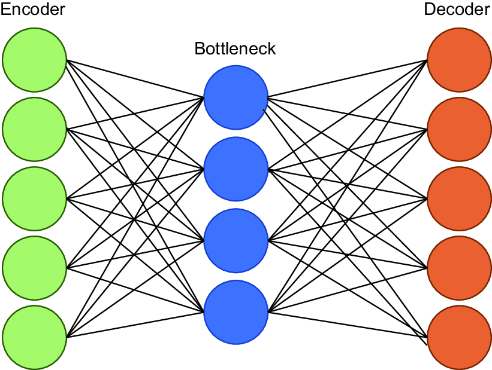
An autoencoder makes information loss visible: an encoder compresses input through a bottleneck, and a decoder reconstructs it, producing outputs that may differ from the originals. section 9.4
