An infrastructure lifecycle strategy treats provisioning, configuration, operation, change, and retirement as a coordinated software engineering process rather than a chain of manual handoffs. It reduces duplicated services, slow changes, inconsistent environments, and rising operational risk. section 1.5 section 2.2
A workable strategy shifts the operating model in several ways:
- Replace isolated technology silos and team-owned queues with composable, reusable capabilities. section 1.5
- Standardize lifecycle practices in a shared team document or charter so expectations remain consistent and onboarding is easier. section 2.2
- Use the platform’s own tools and technologies during its development, applying dogfooding to expose usability and operational gaps. section 2.2
Epetech’s handoff problem
At Epetech, developers coordinate DNS entries, firewall rules, storage, compute, monitoring, alerts, and pipeline changes across teams. Routine changes become slow and risky, environments diverge, releases are bundled, and incidents increase. A lifecycle strategy addresses the fragmented process as a system rather than optimizing each team’s queue independently. section 1.5
Figure 1.7 Infrastructure-oriented changes can go through as many as four handoffs by the time they reach the team that actually does the work. Each of these teams is only allowed to optimize a process within its own team’s scope of responsibilities.
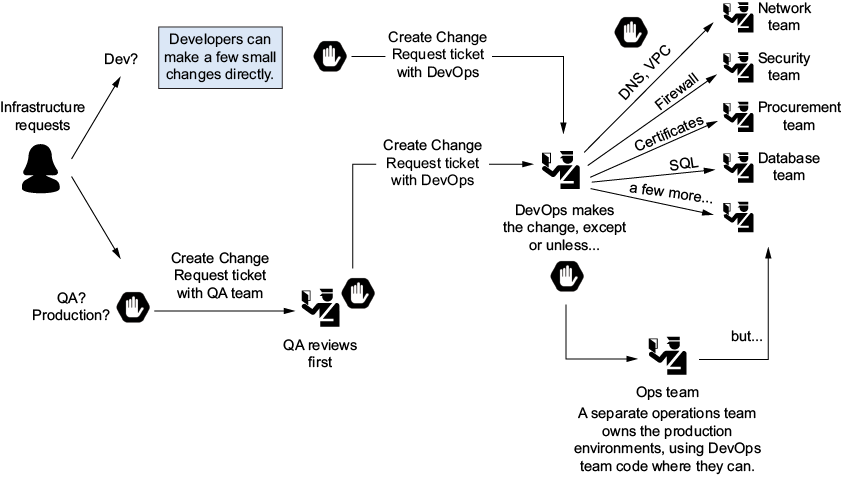
Use the workflow diagram to inspect how infrastructure changes accumulate handoffs before reaching the team that performs the work. section 1.5
