An initialization vector (IV) is a nonsecret value combined with secret keying material to make cryptographic inputs vary between encryptions. It may be transmitted publicly: secrecy comes from the preshared key or cipher key, while the IV prevents every message from starting from the same cryptographic input. section 4.3.2
Figure 4.13 WEP setup showing preshared keys and initialization vectors as input to RC4
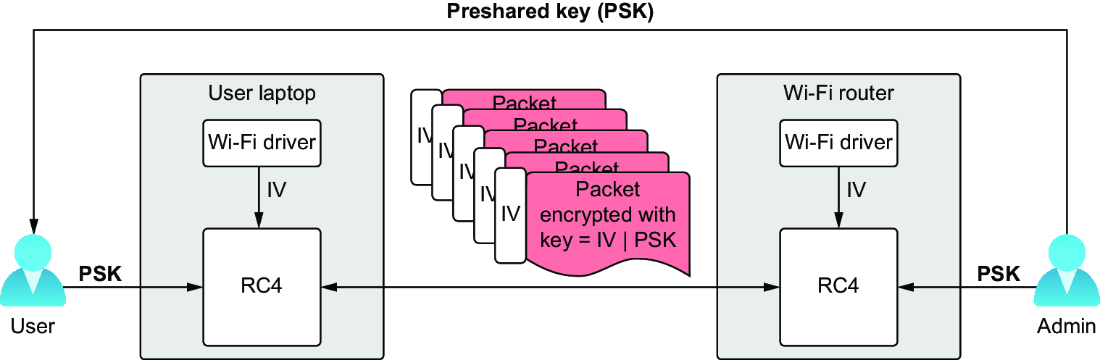
In WEP, each packet carries a public three-byte IV. Sender and recipient concatenate it with the shared PSK to form that packet's RC4 key. section 4.3.2
The security requirement depends on the construction. WEP uses the IV like a nonce: a new IV is intended to ensure that packets protected by one remembered PSK do not reuse the same RC4 key. CBC mode likewise requires a unique IV for each message; a fresh IV must be generated rather than deriving the next one from prior ciphertext. section 4.3.2 section 5.6
Weak WEP IVs
WEP constructs an RC4 key as IV || PSK and exposes the IV with the packet. Certain IVs of the form [L, 255, X] interact with biases in RC4's key-scheduling algorithm. An observer who knows part of a packet plaintext can recover a keystream byte, collect many packets with weak IVs, tally key-byte guesses, and progressively recover the PSK. The IV is public by design; the failure is that chosen IV patterns expose an RC4 weakness. section 4.3.2 section 10.1.2
Reused CBC chaining value
A vulnerable encrypted HTTP session generates an initial AES-CBC IV, then uses the final ciphertext block of one request as the IV for the next. Because that next IV is predictable from observed traffic rather than freshly generated, an attacker can manipulate request plaintext around a cookie and guess the secret byte by byte. TLS 1.1 addresses this BEAST condition with a fresh IV for every underlying message. section 5.5.1 section 10.1.3
Treat IV handling as a cryptographic boundary:
- Generate a new IV for every CBC-encrypted message; do not carry forward the prior ciphertext block as its IV. section 5.6 section 10.1.3
- Do not assume a public IV is harmless when the underlying cipher has IV-dependent weaknesses; WEP's short weak-IV patterns enabled statistical RC4 key recovery. section 4.3.2 section 10.1.2
- Keep the IV distinct from the secret key: recipients may use the transmitted IV with their secret material to reproduce the encryption input. section 4.3.2


