An input method lets people enter characters that cannot be represented directly by the available keyboard keys. It becomes necessary when a language has far more characters than a practical keyboard can hold, as with Chinese. section 5.3
Common strategies match the keyboard to the language:
- Use modifier keys or short key sequences for accented Latin letters, such as typing ` followed by a to produce à. section 5.3
- Print a different alphabet on the same kind of keyboard for languages such as Modern Greek or Russian. section 5.3
- Use specialized keyboards or character-selection lists when a language contains tens of thousands of characters. section 5.4
Entering 樱桃 with Pinyin
Pinyin represents the pronunciation of 樱桃 as “ying” followed by “tao.” After typing each syllable, the computer presents possible characters; the user selects the intended one before continuing. section 5.3
Entering characters with Zhuyin
Zhuyin uses about 40 basic sound symbols arranged on a normal keyboard. Unlike Pinyin, it does not require the user to know Western characters; symbols and tone numbers guide the selection. section 5.3
Figure 5.9 Beginning our word
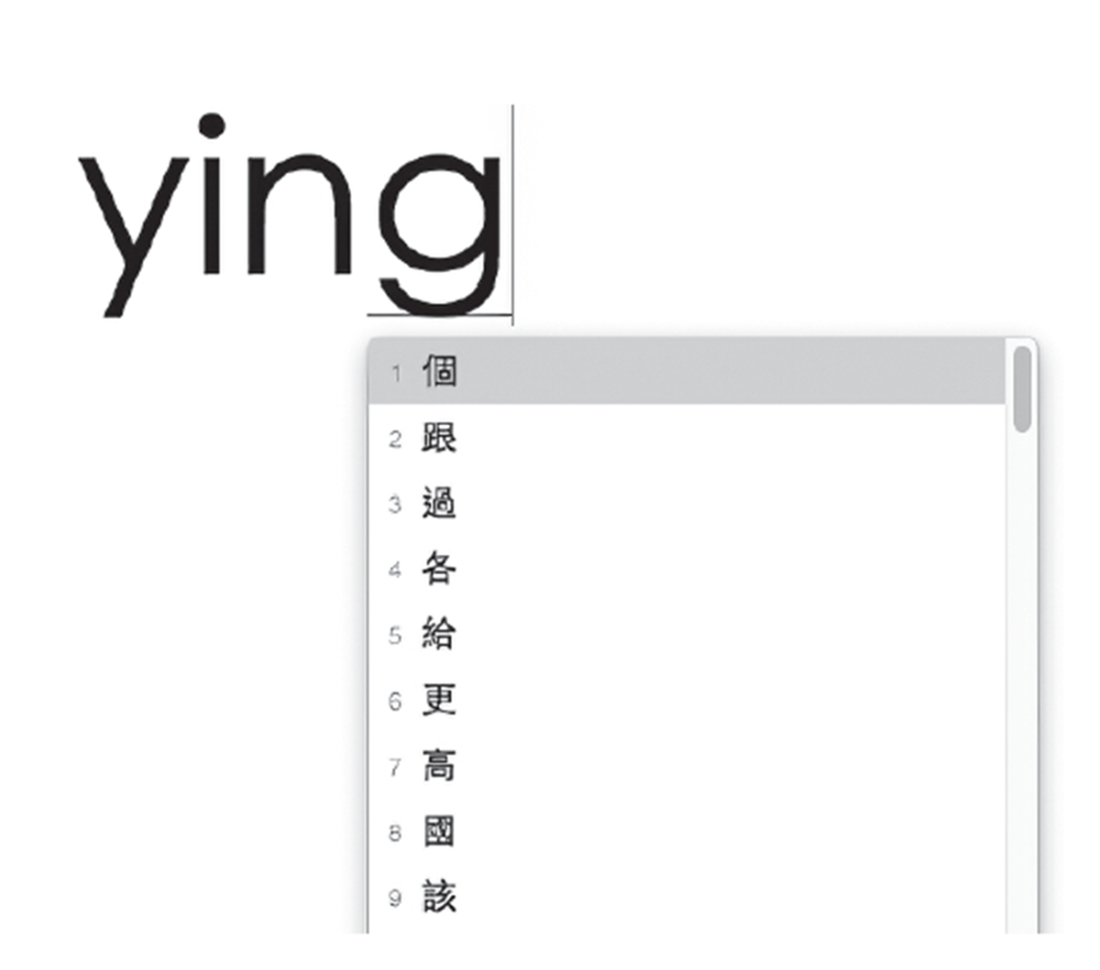
Follow the staged figures showing how Pinyin input begins, narrows character choices, and completes a word. section 5.3