INT16×8 pairs INT8 weights with INT16 activations in an experimental TFLite path, intended to recover accuracy when full-INT8 calibration is fragile. section 11.2
On EfficientNet-Lite0, it produced a 5.40 MB model with 50.6% top-1 accuracy. Synthetic random calibration caused a large accuracy drop; a proper ImageNet calibration shard recovers the gap. section 11.2.1
Inspect the converted flatbuffer to verify the actual tensor types:
- The INT16×8 graph contains 62 INT16, 50 INT8, 50 INT64, 4 INT32, and two FP32 tensors; the FP32 tensors are at the input and output. section 11.2.1
- Use `tf.lite.Interpreter.get_tensor_details()` to enumerate tensor dtypes rather than relying on the converter’s exit status. section 11.2.1
Figure 11.5 EfficientNet-Lite0 size × ImageNet top-1 accuracy across the four TFLite converter paths, measured on a 1,000-image ImageNet val subset. FP32 at 18.55 MB lands at 66.8% top-1 (87.7% top-5), the unquantized baseline. Dynamic-range at 4.88 MB lands at 66.5% top-1 (87.9% top-5). That is a 3.8× file-size reduction with essentially no accuracy loss. INT8 at 5.14 MB lands at 49.0% top-1 (86.8% top-5); INT16×8 at 5.40 MB lands at 50.6% top-1 (87.4% top-5). The 17-percentage-point top-1 cliff on the two activation-quantized paths is a calibration artifact, not a property of the integer kernels. The command ch11_2_tflite.py convert ran with a synthetic uniform-random representative dataset because data/calib/ was empty at conversion time. The top-5 numbers (within one percentage point of FP32 on all four variants) confirm the cliff is calibration-shape, not capacity loss; a proper ImageNet calibration shard recovers the gap.
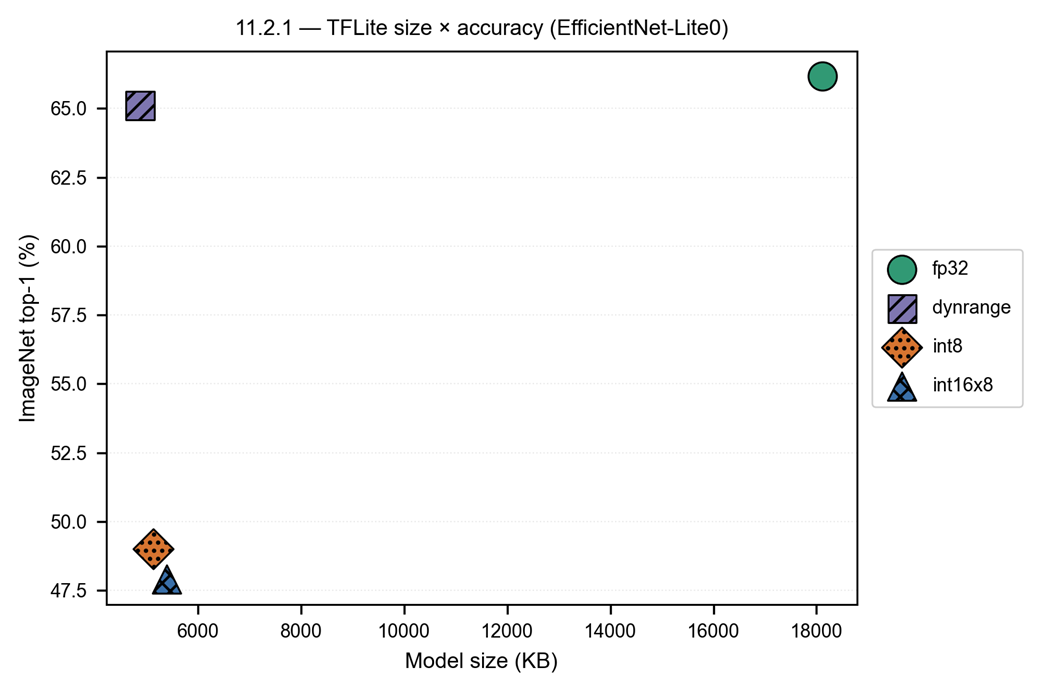
Compare model size and top-1 accuracy across converter paths; the top-5 results help distinguish calibration error from loss of model capacity. section 11.2.1
