liveBook · Manning

Integral term

As explained in Optimization Algorithms: AI techniques for design, planning, and control problems

An integral term is a controller component whose output reflects the accumulated magnitude of error over time.

An integral term is the PID component whose control output reflects both the magnitude and duration of accumulated error—the area under the error curve. It helps reduce steady-state error, though increasing its gain can also increase overshoot and settling time. section 8.7

Room-temperature control

In a heater controller, persistent room-temperature error accumulates over time. The integral contribution therefore grows while the measured temperature remains below the set point, helping the system reach the desired steady state. section 8.7

Figure 8.17 PID-based closed-loop control system—the PID controller takes the error signal and produces a control signal to reduce the error to zero.
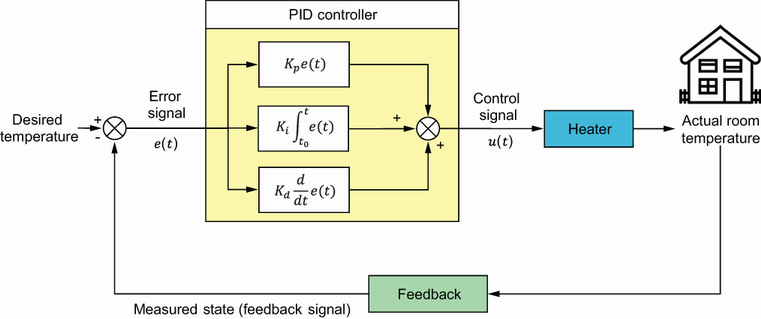
Use the closed-loop diagram to trace how temperature error becomes a heater control signal. section 8.7

How Optimization Algorithms: AI techniques for design, planning, and control problems covers it

How deep it goes
Explains magnitude-and-duration intuition and tuning effects, but does not develop the integral calculation or implementation algorithm.
Examples
Uses room-temperature regulation, a heater, a set point, and a closed-loop control diagram.
What you can do after
Evaluate how integral gain affects steady-state error, rise time, overshoot, and settling time.
How it connects
Links PID controller behavior with proportional term, derivative term, overshoot, settling time, and steady-state error.

This explainer was generated by Manning's knowledge graph from the text of Optimization Algorithms: AI techniques for design, planning, and control problems. The section links point to the parts of the book it draws on.