The intelligence component transforms user inputs into meaningful outputs through AI models and related computational mechanisms. It is one part of a broader solution space alongside data and user experience, while governance can constrain all three. section 1.3.2
Designing the component requires specifying:
- The input type, such as text, images, or time series. section 1.3.2
- The output and the meaning it must carry for the user or system. section 1.3.2
- The model or prompting approach that performs the transformation, such as few-shot prompting for a general-purpose LLM. section 1.3.2
Conversational financial data assistant
A user asks a natural-language question about financial data. The intelligence component transforms that question into a structured SQL query that retrieves the required data. Few-shot examples can guide a general-purpose LLM toward successful transformations. section 1.3.2
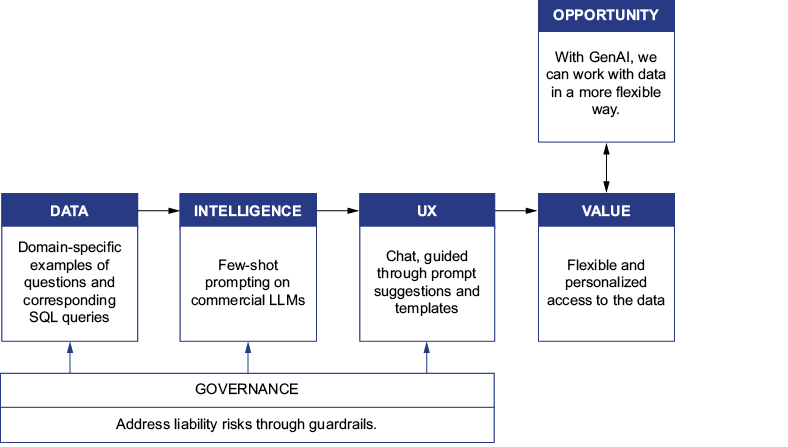
Use the mental model to relate intelligence to the surrounding data and user-experience components. section 1.3.2
