Intelligent behavior is observable performance that appears to show capabilities such as reasoning, creativity, adaptability, and contextual responsiveness. Judging behavior is different from establishing what a system understands or experiences internally. section 1.3.4 section 1.1.4
The Turing test gives this distinction an operational form. A judge exchanges written messages with a human and a machine whose identities are hidden. If the judge cannot reliably distinguish them, the machine passes the test. The test assesses conversational performance, not consciousness or intent. section 1.3.4
Figure 1.5 The Turing Test. A human judge engages in written dialogue with two unseen participants. One is human and the other a machine, but their identities are hidden from the judge. If the judge cannot reliably distinguish the machine from the human based on their responses, the machine is said to pass the test.
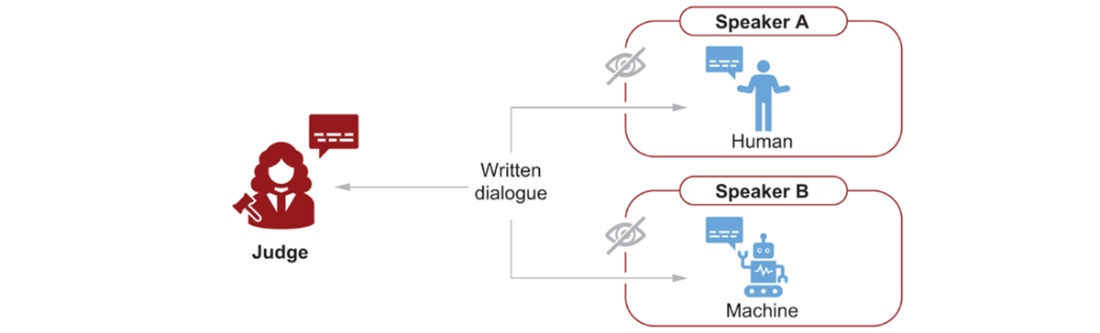
The diagram shows the hidden participants and written exchanges used to assess whether a judge can distinguish the machine from the human. section 1.3.4
Large language models make the distinction consequential: their coherent, context-aware outputs resemble understanding, but emerge from architectural and training choices. Fluency alone does not settle what intelligence or meaning should mean, nor should it be dismissed simply because it arises from computation. section 4.0 section 1.1.4
Warmth without care
A system can respond warmly, recall prior exchanges, and maintain conversational continuity without having the capacity for care in a relational sense. The rollback of an overly flattering GPT-4o update illustrates how conversational style can shape users’ impressions of a relationship. section 8.5.4
Evaluating intelligent behavior therefore requires attention both to what a system does and to the limits of what its performance establishes. The standards used to interpret that behavior involve philosophical judgment as well as engineering measurement. section 1.1.4
