A user asks a reasonable question, but the chatbot says, “I didn’t understand.” The problem may not be the user’s wording: the question may fall outside the bot’s predefined intents. An intent-based chatbot classifies an utterance into a trained category, then follows its associated dialogue flow or returns a prewritten answer. This works well for common questions with answers the team can specify in advance. section 6.1 section 4.4.2
When the category is too broad—or missing
A banking bot trained to check account balances may not recognize a question about interest rates. Asking the user to rephrase cannot fix that missing coverage. A bot that recognizes a question about side effects may give an accurate but generic answer while missing the nuance of a question about ibuprofen and blood pressure. section 4.4.2 section 6.1
Choose how to handle requests beyond the predefined paths:
- For likely matches to several intents, let topic disambiguation ask the user which goal they mean. Avoid assuming that several matches prove the user has several goals. section 4.4.2
- For a relevant but unsupported goal, record the topic and monitor its volume for future coverage. Do not label it with a golden intent that has not been trained. section 4.4.2
- For low-confidence classifications, route the question to search when available. Search can return relevant documents or passages; retrieval-augmented generation (RAG) can use passages to form a more specific answer. section 6.1.2 section 6.1
Figure 6.6 Intents and searches have complementary functions. A search-augmented bot uses intent-based answers when it recognizes the utterance with high confidence; otherwise, it defers to search. Using intents and search together improves chatbot capabilities, but this approach still has some limitations.
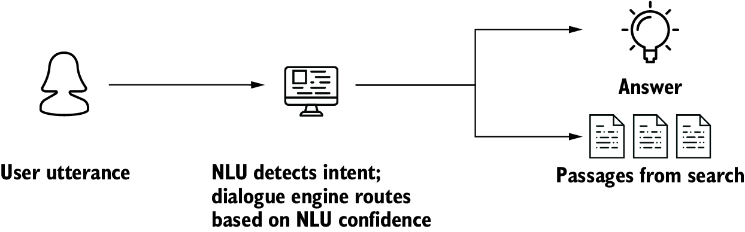
The diagram shows the decision point: return a prepared answer for a high-confidence intent, or pass the utterance to search. section 6.1.2
The trade-off is coverage versus control. Prewritten intent answers can be accurate when classification is confident, but uncommon questions and added nuance require more categories and ongoing maintenance. Search broadens what the bot can find; RAG aims to answer from retrieved passages. Compare approaches against the questions users actually ask, the effort of keeping knowledge current, and whether a generic answer leaves their goal unmet. section 6.1 section 6.2.4
