A chatbot can struggle when users ask the same question in different ways. An intent-based system groups those utterances under one intent, then returns a builder-defined response. section 2.1.2
The mental model is simple: an utterance is the user’s input, an intent groups utterances with similar meanings, and a response is the chatbot’s answer. “What time are you open?” and “What are your hours?” can both map to #store_hours. section 2.1.2
This pattern works best when response control matters:
- Train each intent with example utterances; modern systems may need as few as five examples per intent. section 2.1.2
- Edit and format exact responses, including graphical elements, while recognizing that many intents increase training difficulty and reduce adaptation to nuance. section 2.1.2
Cake Bot FAQ
Map “What do you sell?” to #cake_options and answer with the occasions served. Map “How much does a cake cost?” to #cost and return the fixed price and delivery fee. section 2.1.2
Figure 2.2 Question-answering bots map user utterances to intents, which map to answers.
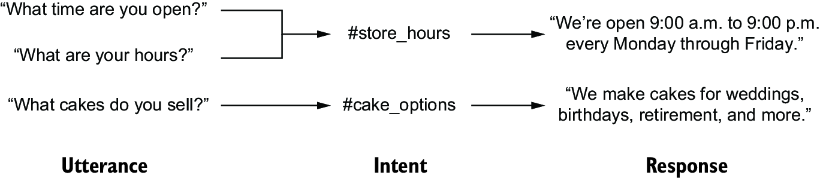
Use the mapping diagram to trace the flow from user utterance to recognized intent to predefined answer. section 2.1.2
