liveBook · Manning

Inter-area route

As explained in Acing the CCNA Exam: Volume 1 Fundamentals and Protocols

An inter-area route reaches a destination in an OSPF area other than one to which the router is directly connected.

An inter-area route reaches a destination in an OSPF area that the router does not connect to directly. It differs from an intra-area route, which reaches a destination within the router’s own area, and an external route, which reaches outside the OSPF autonomous system. section 18.1.2

Area 2 destination

An ABR connected to areas 0 and 1 that learns a route to area 2 has learned an inter-area route. In a multi-area OSPF design, traffic between non-backbone areas passes through area 0. section 18.1.2

Figure 18.2 A multi-area OSPF network consisting of four areas. Area 0 is the backbone area to which other areas must connect. Areas 1, 2, and 3 are non-backbone areas, and traffic between them must pass through area 0.
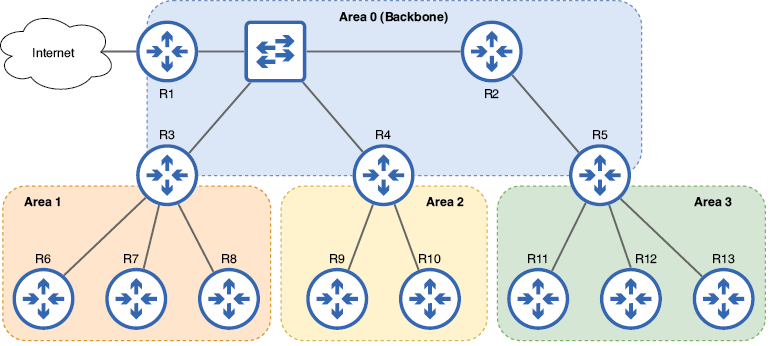
Use the multi-area topology to trace how area membership determines whether a destination is intra-area or inter-area. section 18.1.2

How Acing the CCNA Exam: Volume 1 Fundamentals and Protocols covers it

How deep it goes
Defines the category and gives an ABR example, but stops short of route-calculation or configuration details.
Examples
Uses an ABR learning an area 2 route and a four-area topology with area 0 as the backbone.
What it assumes
Uses OSPF areas and router connectivity while distinguishing intra-area, inter-area, and external routes.
What you can do after
Evaluate OSPF route categories and identify inter-area destinations from router and destination area membership.
How it connects
Links OSPF areas with intra-area routes, external routes, area border routers, and the backbone area.

Related concepts

This explainer was generated by Manning's knowledge graph from the text of Acing the CCNA Exam: Volume 1 Fundamentals and Protocols. The section links point to the parts of the book it draws on.