liveBook · Manning

Interaction potential

As explained in Machine Learning Algorithms in Depth

An interaction potential is a positive function assigning a compatibility weight to the joint states of variables connected by an edge.

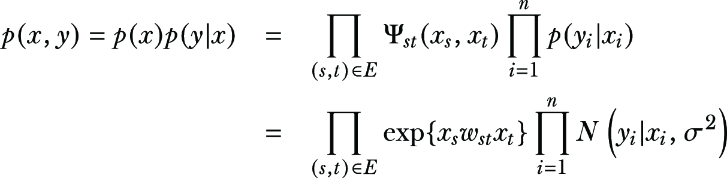
An interaction potential is a positive compatibility function over the joint states of variables joined by an edge. In an Ising model, Ψ(xₛ, xₜ) = exp{xₛJxₜ} is higher when neighboring binary variables share the same state. section 3.3

The potential encodes a smoothness preference: neighboring pixels are encouraged to have the same color while noisy observations are reconciled with latent binary pixel states. section 3.3

Image denoising

For a two-dimensional grid of noisy observations, assign each latent pixel xᵢ one of −1 or +1. Set the coupling strength J > 0 so adjacent pixels receive greater compatibility when their states agree. section 3.3

(3.14)
figure

Use the joint-distribution equation to inspect where pairwise interaction potentials enter the Ising model. section 3.3

How Machine Learning Algorithms in Depth covers it

How deep it goes
Defines the pairwise exponential form and its smoothness effect, then uses it within mean-field variational inference.
Examples
Uses binary latent pixels on a two-dimensional grid and a positive coupling strength to demonstrate image denoising.
What it assumes
Assumes familiarity with random variables, undirected graphs, binary states, and conditional independence.
What you can do after
Understand how pairwise potentials express smoothness preferences in an Ising denoising model.
How it connects
Connects interaction potentials to Markov random fields, Ising models, coupling strength, and variational inference.

Related concepts

This explainer was generated by Manning's knowledge graph from the text of Machine Learning Algorithms in Depth. The section links point to the parts of the book it draws on.