An internal development team builds software to solve business problems. Its software engineers take ownership of what they make and develop a shared understanding of the domain with domain experts. section 2.2.2
Treat the team as one stakeholder category within collaborative modeling:
- Include software engineers who own the software they build. section 2.2.2
- Work with domain experts to understand the business problems rather than assuming developers are users, customers, or domain experts. section 2.2.2
- Invite relevant stakeholders—and, when possible, additional stakeholders whose different perspectives may reveal useful insights. section 2.2.2
BigScreen ticketing
When many customers abandon online movie-ticket purchases and finish at the theater register, the development team can work with product, UX, and other domain experts to understand the business problem before changing the system. section 2.2.2
Figure 2.3 This Venn diagram illustrates the interrelationships between four primary categories of stakeholders in a project or business context: Domain Experts, Users, Development Team, and Customers. Each category is depicted by overlapping shapes, indicating that stakeholders can simultaneously fulfill multiple roles. For example, a stakeholder may possess the specialized knowledge of a Domain Expert while also being a Customer of the product or service. This visual aid helps to identify the complex positions stakeholders may hold and the potential for shared interests and expertise among them.
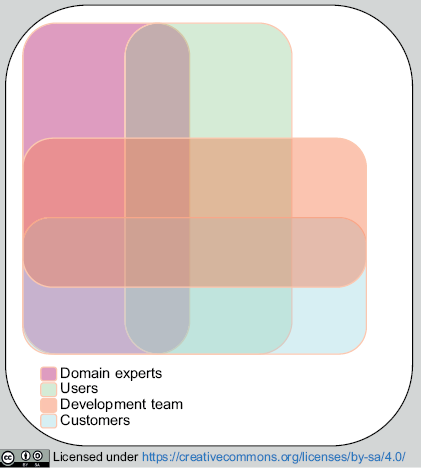
Use the stakeholder diagram to identify overlapping roles: a development team member may also be a user, customer, or domain expert. section 2.2.2

