Data representation is an encoding of data used as input to an ML model. It may be manually engineered or produced by a more complex model; learned vectors are often called representations or embeddings. section 6.2.3
Use representations to make data useful across the ML lifecycle:
- Generate representations for users, goods, images, videos, text, or audio with a shared model, then let applied teams use them for specific business problems. section 6.2.3
- Reuse representations from pretrained models as inputs to a simple model when data is limited and the target task is relatively simple. section 8.4
- Specify how representations are generated when documenting ETL, filtering, and feature-engineering decisions. section 6.7
- Store embeddings centrally when doing so reduces repeated processing, keeps features consistent, or supports similarity search. section 11.4.1
Image classification baseline
Take the representation from the last backbone layer of an ImageNet-trained model and train a simple linear classifier for custom image classes. This can outperform more elaborate models when the dataset is small. section 8.4
Figure 11.12 A landscape of ML problems with various needs for a feature store
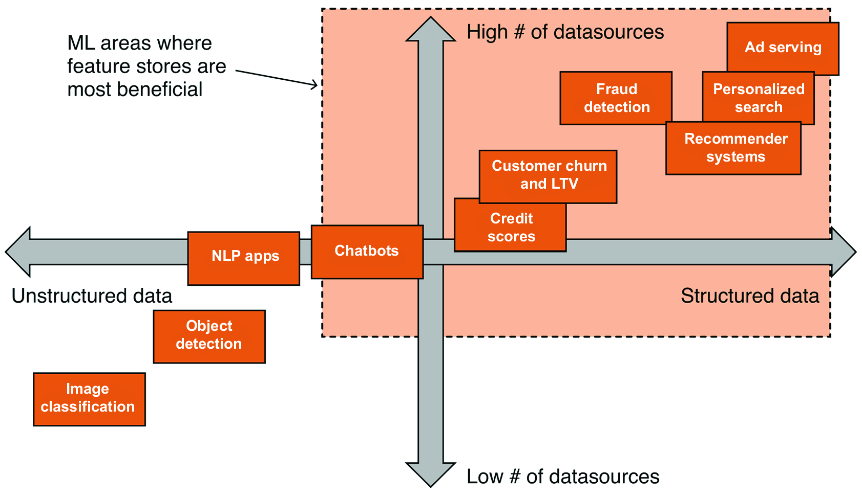
Use the landscape to compare where centralized storage helps, especially when embeddings join tabular, image, text, or review data in multimodal systems. section 11.4.1



