A neural network’s internal representation is its learned encoding of input information. During grokking, the representation’s measured complexity rises as the network memorizes training data, then falls as it settles on a simpler pattern that generalizes. This shift appears with sufficient regularization; without it, complexity stays high and the network does not generalize. section 8.5
Figure 8.7 Complexity dynamics for unregularized (top) and regularized (bottom) neural networks in grokking experiments on modular multiplication. Markers denote when memorization (□) and generalization (○) occur. In the regularized network, generalization occurs when complexity falls after peaking at memorization, whereas the unregularized network never generalizes and its complexity remains high. Mean over three seeds; shading indicates the standard error. Used with permission granted by the lead author (Branton DeMoss).
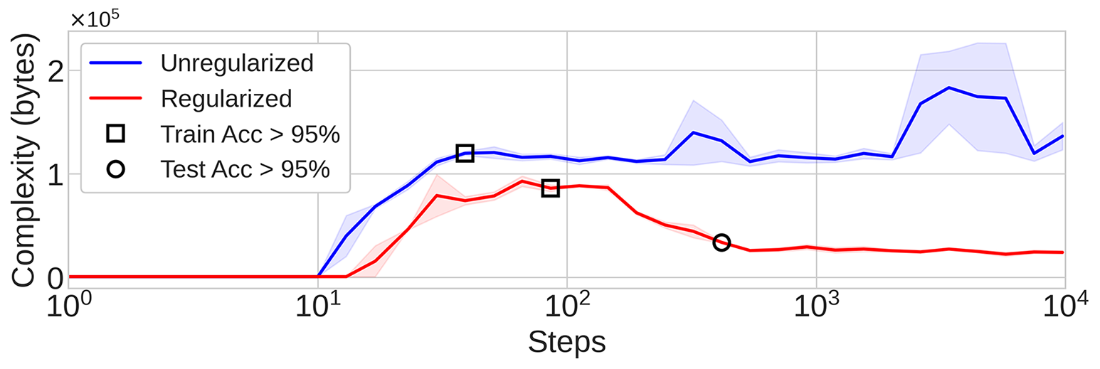
Compare complexity over training for regularized and unregularized networks on modular multiplication. section 8.5
