An intrinsic hallucination is a generated response that stays grounded in the provided source but misrepresents facts shown there. It combines contextual grounding with factual misalignment. section 5.1.2 section 5.5
Classify source-grounded outputs by two independent questions:
- Does the response remain within the provided source, or introduce unsupported information? section 5.1.2
- Does each claim match verifiable facts, or contradict them? section 5.1.2
- Intrinsic hallucination occupies the grounded-but-misaligned quadrant; extrinsic hallucination is both ungrounded and misaligned. section 5.5
Financial report example
A source states, “Q3 revenue was $2.3 billion, a 15% increase year-over-year.” Writing “Q3 revenue was $2.3 billion, a 5% increase year-over-year” uses the source’s data but changes a fact. Comparing output claims with source claims exposes the contradiction. section 5.1.2
Figure 5.3 The LLM Reliability Quadrant. Contextual grounding (vertical axis) asks whether the output stays within the provided sources. Factual alignment (horizontal axis) asks if the output is correct according to verifiable evidence. The safest output is both grounded and aligned. The riskiest output is neither grounded nor aligned. The mixed-signal quadrants are operationally important because the output can look based on source but wrong, or look correct but not grounded.
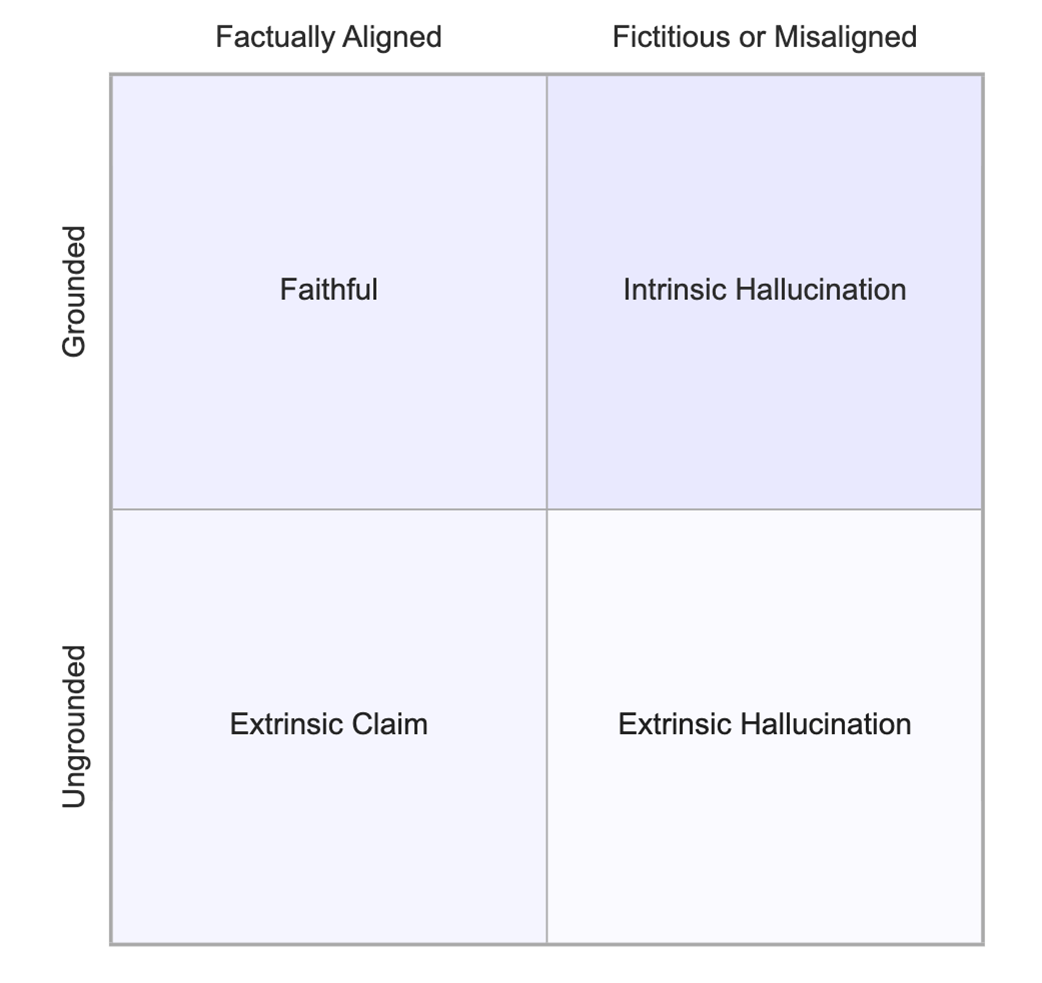
Use the reliability quadrant to separate contextual grounding from factual alignment and identify mixed-signal failures. section 5.1.2
In retrieval-augmented generation, low faithfulness with strong context scores indicates a generation problem, including intrinsic hallucination from misreading retrieved evidence. section 6.5

