liveBook · Manning

Inventory

As explained in Acing the CCNA Exam: Volume 2 Advanced Networking and Security

An Ansible inventory is a file that lists managed hosts and can organize them into groups with associated variables.

An Ansible inventory identifies the managed hosts that automation targets. It is usually a YAML file and may organize hosts into groups with variables assigned to individual hosts or groups. section 25.2.1 section 25.3

Use the inventory as the host foundation for Ansible automation:

  • Define the hosts Ansible manages. section 25.3
  • Organize hosts into groups for shared targeting and variables. section 25.2.1
  • Connect inventory targets to playbooks, which define management tasks and procedures. section 25.2.1
Figure 25.5 Basic Ansible operations. Inventory, template, and variable files define configurations, and playbooks define actions. The control node uses SSH to connect and push configurations to managed devices.
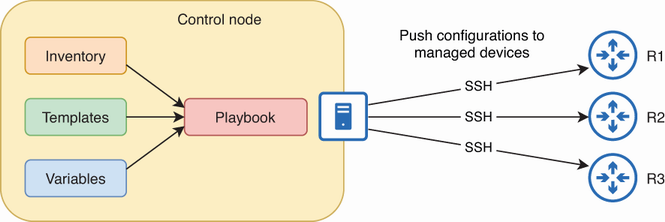
Trace how inventory, templates, variables, and playbooks combine at the control node before SSH pushes configurations to managed devices. section 25.2.1


How Acing the CCNA Exam: Volume 2 Advanced Networking and Security covers it

How deep it goes
Defines hosts, groups, and variables but does not provide inventory syntax or operational verification steps.
Examples
Uses a basic Ansible operations diagram showing inventory alongside template and variable files.
What it assumes
Assumes familiarity with Ansible’s control node, playbooks, and SSH access to managed devices.
What you can do after
Understand how host definitions support Ansible’s push-based configuration workflow.
How it connects
Connects managed hosts with playbooks, variables, templates, modules, tasks, the control node, and SSH.

Also explained in

Compare how 2 books explain inventory →

This explainer was generated by Manning's knowledge graph from the text of Acing the CCNA Exam: Volume 2 Advanced Networking and Security. The section links point to the parts of the book it draws on.