Inverse reinforcement learning (IRL) infers an agent’s reward function from observed behavior or trajectories. Standard reinforcement learning usually starts with a reward function and optimizes behavior; IRL reverses that direction, making it useful when the desired objective is demonstrated rather than explicitly specified. section 10.4 section 5.0
IRL is closely related to reward modeling, but the practical emphasis differs:
- IRL learns a reward function from an agent’s behavior. section 10.4
- RLHF reward models learn a signal from human preference data, often predicting which completion is preferred. section 5.0
- Both approaches supply or approximate the learning signal used by reinforcement learning, while differing in implementation and focus. section 5.0
Figure 5.1 The RM in RLHF plays the role of the environment component that returns rewards in standard RL. The key difference is that in RLHF, we get to control and learn this reward function from human preferences, rather than it being fixed by the environment.
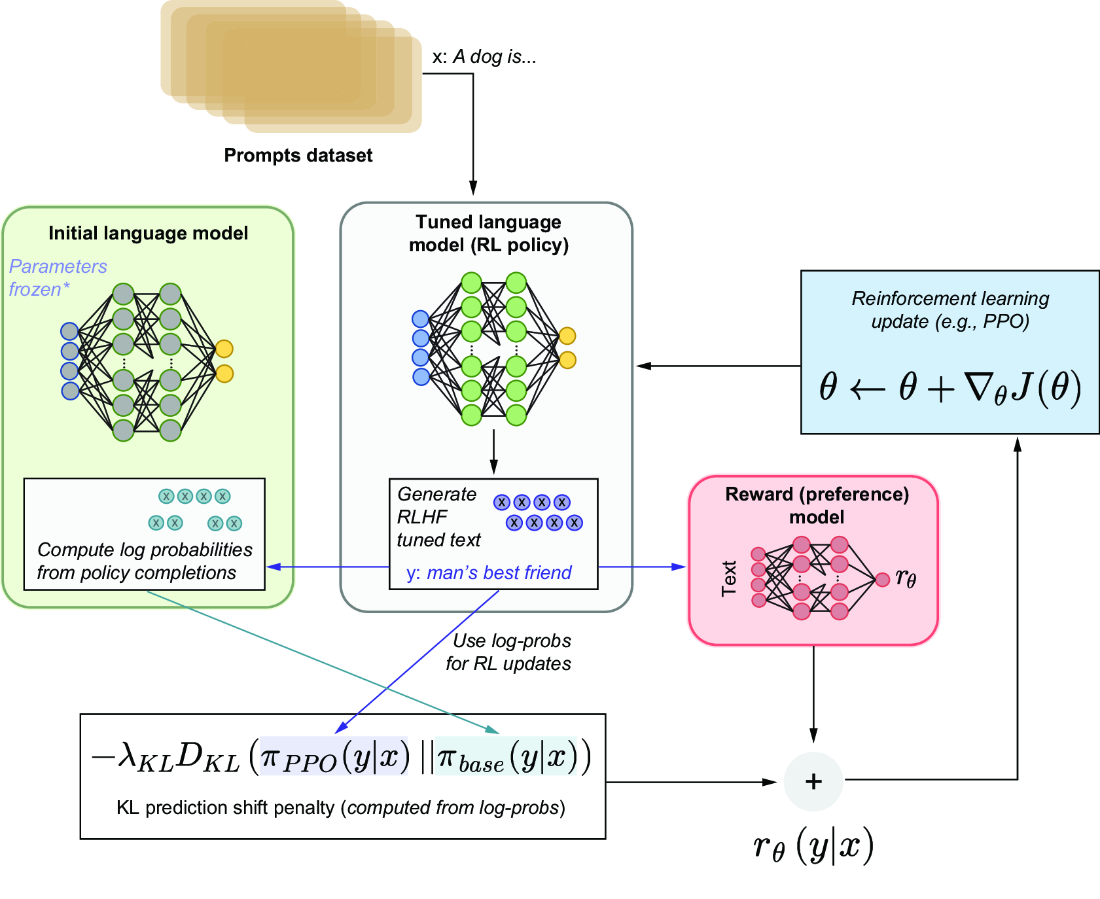
Shows how a learned reward model replaces the fixed environment reward as the learning signal in RLHF, clarifying IRL’s relationship to reward modeling. section 5.0
