io.Writer is Go’s abstraction for sending byte data to a destination. Functions that accept it can write to files, terminals, memory buffers, network connections, or other compatible destinations without changing their core logic. section 10.3 section 2.8.2
The interface separates what a function writes from where the output goes. A processing function can accept an io.Writer alongside an io.Reader, then support file input, operating-system input, file output, or screen output through the same design. section 10.3
Formatted output to a selected destination
var writer io.Writer writer = os.Stdout fmt.Fprintf(writer, "Output written to: %s\n", outputFile) Replacing writer with another compatible destination redirects the formatted message without changing the call. This pattern fits CLI tools and logging systems. section 10.3
Use io.Writer when:
- A function should write output without depending on a concrete file or terminal type. section 2.8.2
- A CLI or conversion utility needs to send results or status messages to selectable destinations. section 10.3 section 10.0
- Several destinations should receive the same stream through io.MultiWriter. section 10.3
Figure 10.1 io.Reader and io.Writer interface composition with multiple package implementations
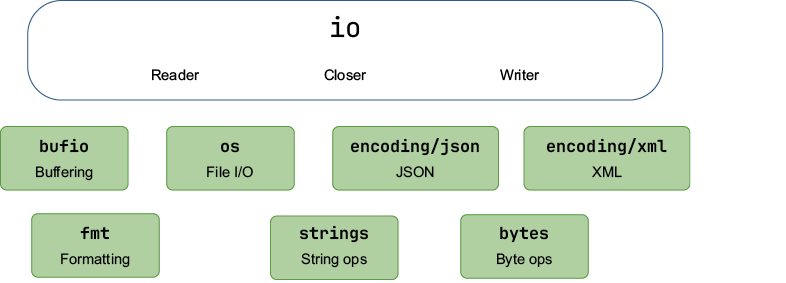
Browse the interface relationships and package implementations that let one Writer-based function operate across multiple destinations. section 10.3

