liveBook · Manning

Static inference

As explained in Domain-Specific Small Language Models

Single-pass model inference without iterative refinement or adaptive postprocessing of the generated response.

Static inference generates a response in one model-inference pass, without iterative refinement or adaptive postprocessing. It contrasts with test-time compute methods that repeatedly query a service and refine candidate answers. section 15.2

Operational characteristics include:

  • Uses a conventional model API call to produce the response directly. section 15.2
  • Avoids the extra latency and computation of repeated calls, candidate search, reflection, or aggregation. section 15.2
  • Can run behind OpenAI-compatible services, including commercial APIs and local inference servers. section 15.2
Figure 15.1 The flow of requests and responses through the OptiLLM proxy
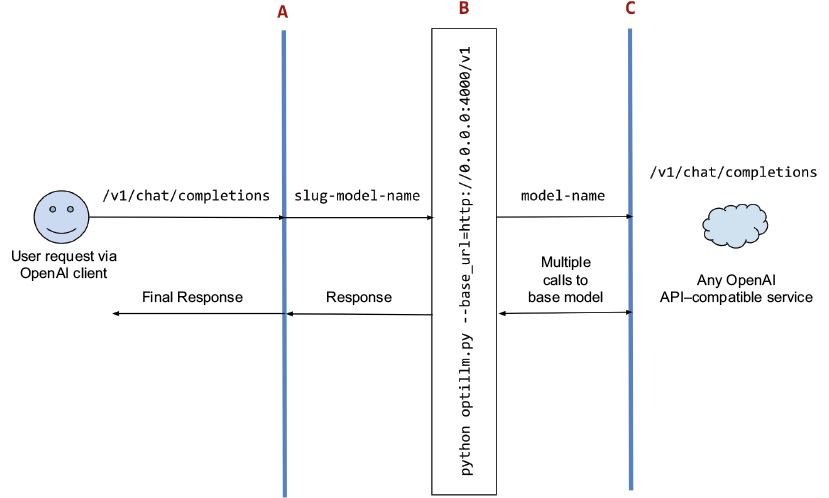
Trace how a client request reaches an OpenAI-compatible service that performs static inference, with optional refinement occurring in a separate proxy layer. section 15.2

How Domain-Specific Small Language Models covers it

How deep it goes
Defines single-pass generation and contrasts it with proxy-based iterative refinement, without detailing model internals.
Examples
Illustrates static inference through direct API servicing and the service layer inside the OptiLLM request flow.
What you can do after
Evaluate whether a response pipeline adds computation beyond a single model call.
How it connects
Connects static inference with test-time compute, iterative refinement, inference proxies, and OpenAI-compatible APIs.

Related concepts

This explainer was generated by Manning's knowledge graph from the text of Domain-Specific Small Language Models. The section links point to the parts of the book it draws on.