IP Precedence (IPP) is the legacy three-bit QoS marking field that occupied the three most significant bits of the former IPv4 Type of Service byte. Modern IP headers use the six-bit DSCP field instead. section 10.3.3 section 10.7
Use these distinctions when interpreting QoS markings:
- IPP provided eight possible marking values because it used three bits. section 10.3.3
- DSCP replaced IPP as the modern six-bit marking field, providing 64 possible values. section 10.3.3 section 10.7
- Class Selector (CS) preserves compatibility with IPP by using the same three most significant bits and setting the remaining three bits to zero. section 10.7
- Do not confuse IPP with PCP/CoS: PCP is a three-bit field in an 802.1Q Ethernet tag and does not remain with the packet end to end. section 10.7
Figure 10.12 The old and current definitions of the ToS/DiffServ byte. The old ToS byte defined the 3-bit IPP field for QoS marking. The current DiffServ byte defines the six-bit DSCP field for QoS marking.
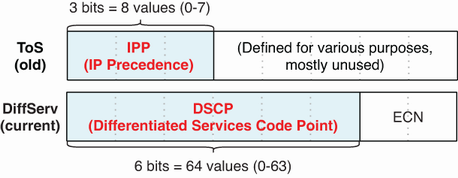
Compare the former Type of Service layout containing IPP with the current DiffServ layout containing DSCP. section 10.3.3
