The Cisco IOS global-configuration command ip routing enables Layer 3 packet forwarding on a multilayer switch. Without it, the switch cannot route packets between VLANs or subnets. section 12.4.2
Use ip routing as the foundation for multilayer-switch routing:
- Configure an SVI for each VLAN with interface vlan vlan-id and an IP address; hosts use the SVI address as their default gateway. section 12.4.2
Basic multilayer-switch configuration
SW1(config)# ip routing SW1(config)# interface vlan 10 SW1(config-if)# ip address 172.16.1.1 255.255.255.192 SW1(config-if)# interface vlan 20 SW1(config-if)# ip address 172.16.1.65 255.255.255.192 SW1(config-if)# interface vlan 30 SW1(config-if)# ip address 172.16.1.129 255.255.255.192
Figure 12.11 SW1, a multilayer switch, routes a packet from PC1 to PC5. SW1 has three SVIs: VLAN 10 (172.16.1.1), VLAN 20 (172.16.1.65), and VLAN 30 (172.16.1.129), allowing SW1 to route packets internally, without relying on an external router.
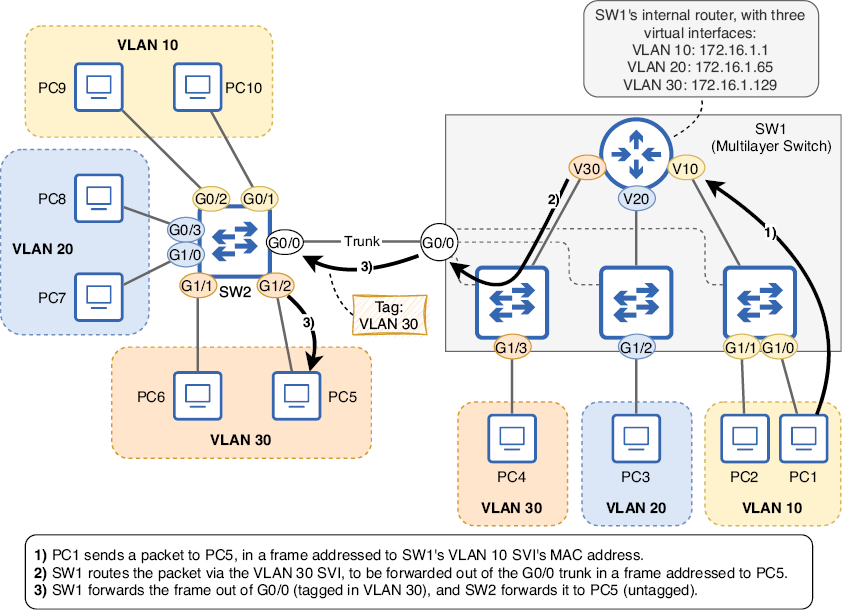
Trace how SW1 routes traffic between VLAN 10 and VLAN 30 through its SVIs without relying on an external router. section 12.4.2
