An IPsec VPN tunnel securely connects peer VPC networks by encrypting traffic at one VPN gateway and decrypting it at the other while traversing the public internet. section 10.1.1 section 10.1.2
Use IPsec VPN when network separation or cross-environment connectivity is required:
- Connect services in separate VPCs, such as Anthos workloads in anthos_vpc and non-Anthos resources in product_1_vpc. section 10.1.1
- Connect GCP with on-premises data centers or other public-cloud environments through Cloud VPN. section 10.1.2
- Add redundant VPN connectivity when higher uptime and throughput justify the additional cost. section 10.1.2
- Increase ingress and egress bandwidth by deploying multiple tunnels; each tunnel supports up to 3 gigabits per second total. section 10.1.2
Choosing connectivity for separated environments
A platform can connect Anthos GKE services in anthos_vpc to product services in product_1_vpc with an IPsec VPN tunnel. This avoids exposing traffic directly to the public internet, but internet transit may reduce performance. VPC Network Peering offers stronger performance when administrative coordination, non-overlapping addresses, and separate firewall rules are acceptable. Cloud Interconnect is the recommended robust option for GCP-to-on-premises connectivity, while Cloud VPN is easier to establish and can serve as a secondary connection. section 10.1.1 section 10.1.2
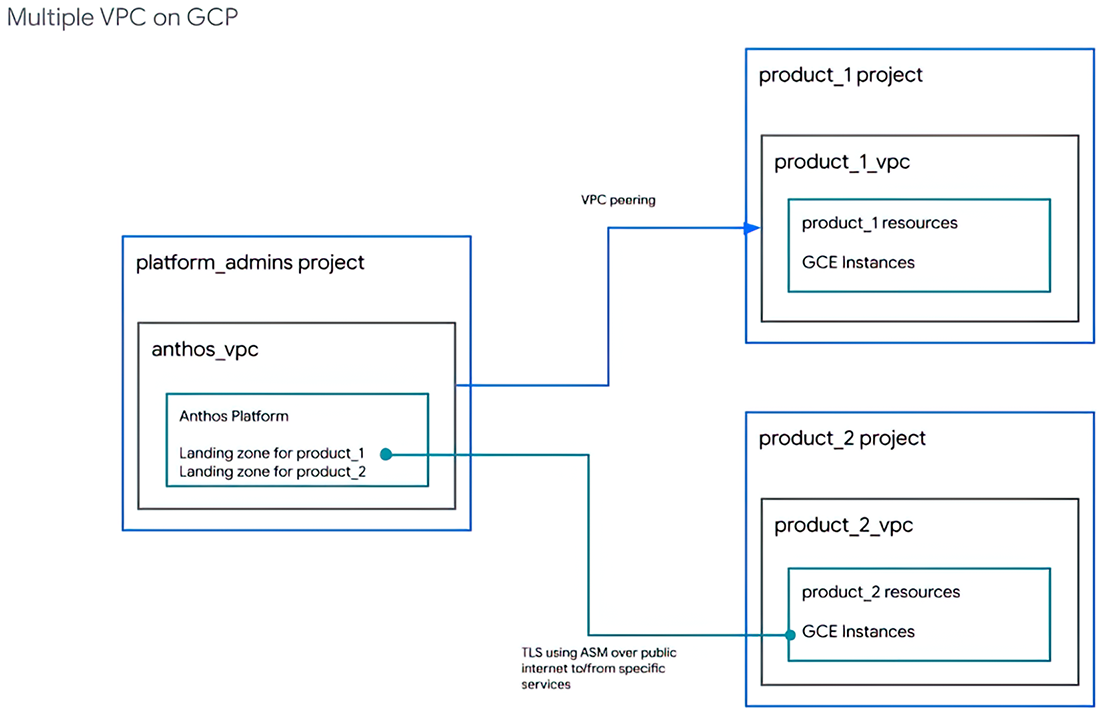
Use the multiple-VPC architecture to inspect where an IPsec VPN fits between separated platform and product networks. section 10.1.1
