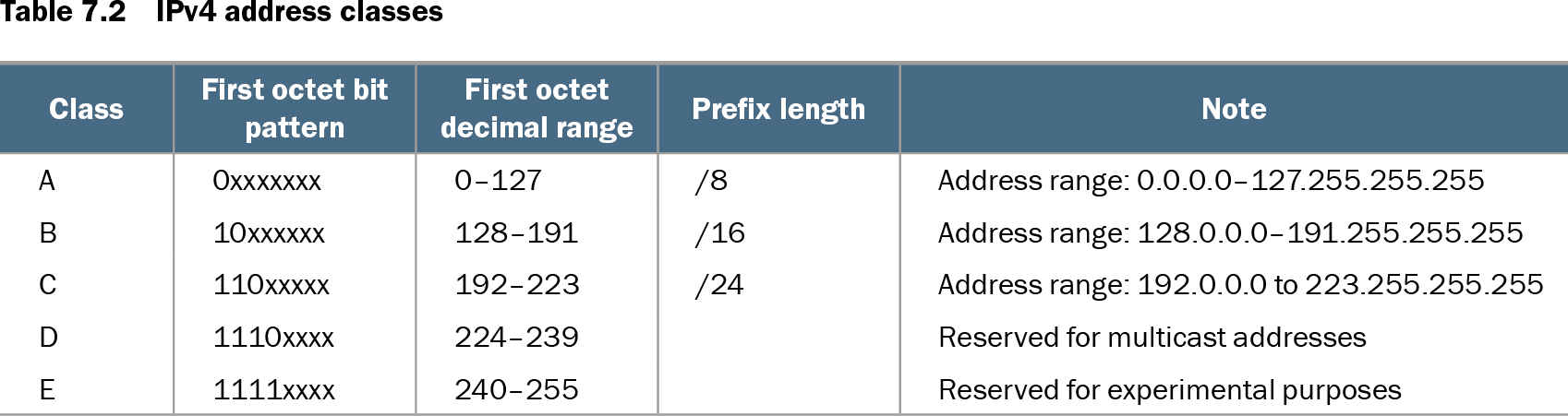
Class A is an IPv4 address class identified by a first octet from 0 through 127. It uses an /8 prefix, or 255.0.0.0, leaving 24 bits for hosts. The classful model is now obsolete, replaced by classless networking. section 7.3.4 section 7.4
Use these points to recognize the class and its practical limits:
- Binary identifiers begin with 0, producing the decimal first-octet range 0–127. section 7.3.4
- The full address range is 0.0.0.0–127.255.255.255, although first octets 0 and 127 are reserved. section 7.3.4
- Class A provides 128 possible networks and 16,777,216 addresses per network in the classful calculation. section 7.3.4
Table 7.2 IPv4 address classes (view table figure)
| Class |
First octet bit pattern |
First octet decimal range |
Prefix length |
Note |
|---|---|---|---|---|
| A |
0xxxxxxx |
0–127 |
/8 |
Address range: 0.0.0.0–127.255.255.255 |
| B |
10xxxxxx |
128–191 |
/16 |
Address range: 128.0.0.0–191.255.255.255 |
| C |
110xxxxx |
192–223 |
/24 |
Address range: 192.0.0.0 to 223.255.255.255 |
| D |
1110xxxx |
224–239 |
Reserved for multicast addresses |
|
| E |
1111xxxx |
240–255 |
Reserved for experimental purposes |
Compare Class A with Classes B, C, D, and E by bit pattern, first-octet range, prefix length, and reserved purpose. section 7.3.4