A platform type is a Java type whose nullability annotations are absent, so Kotlin cannot determine whether values may be null. Kotlin lets you use the value as either nullable or non-nullable, preserving interoperability while making you responsible for safe operations. section 7.12 section 7.12.1
Choose how to handle an unannotated Java property
A Java class declares `String getName()` without nullability information. Kotlin can dereference the result directly: `fun yellAt(person: Person) { println(person.name.uppercase() + "!!!") }` If `name` is null, this fails at the usage site with a `NullPointerException`. Treating the result as nullable is safer: `fun yellAtSafe(person: Person) { println((person.name ?: "Anyone").uppercase() + "!!!") }` The compiler also accepts either assignment: `val s: String? = person.name` or `val s1: String = person.name`. IDE inlay hints may display the platform type with an exclamation mark. section 7.12.1
When consuming Java APIs, make the missing contracts explicit:
- Check Java documentation and, when necessary, implementation code to determine whether a returned value can be null. section 7.12.1
- Use a null check or nullable type when the value may be absent; use direct access only when non-null behavior is known. section 7.12.1
- When implementing Java methods, choose parameter nullability deliberately; Kotlin can override a Java `String` parameter with either `String` or `String?`. section 7.12.2
- For Java collections, decide independently whether the collection, its elements, and its mutability are nullable or mutable. section 8.2.4
Figure 7.10 Java types without special annotations are represented in Kotlin as platform types. You can choose to use them either as nullable or non-nullable types.
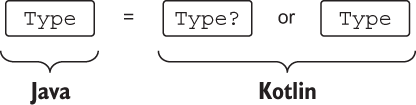
Use the figure to compare annotated Java types, which become explicitly nullable or non-nullable in Kotlin, with unannotated types, which remain platform types. section 7.12.1
