liveBook · Manning

Isomer

As explained in Build AI Drug Discovery Pipelines

An isomer is one of multiple compounds with the same molecular formula but different structural arrangement or spatial orientation.

An isomer is a compound that shares a molecular formula with another compound but differs in structural arrangement or spatial orientation. Isomeric SMILES preserve these connectivity and stereochemistry differences in a molecular representation. section 1.2.1

Distinguish isomers by what changes:

  • Constitutional isomers change how atoms are connected; butane and isobutane both have formula C₄H₁₀. section 1.2.1
  • Tautomers change hydrogen positions and single- or double-bond arrangements, allowing interconversion. section 1.2.1
  • Stereoisomers retain the same connectivity but differ in spatial arrangement; chirality describes structures that cannot be superimposed on their mirror images. section 1.2.1
Figure 1.3 Example pairs of isomeric SMILES.
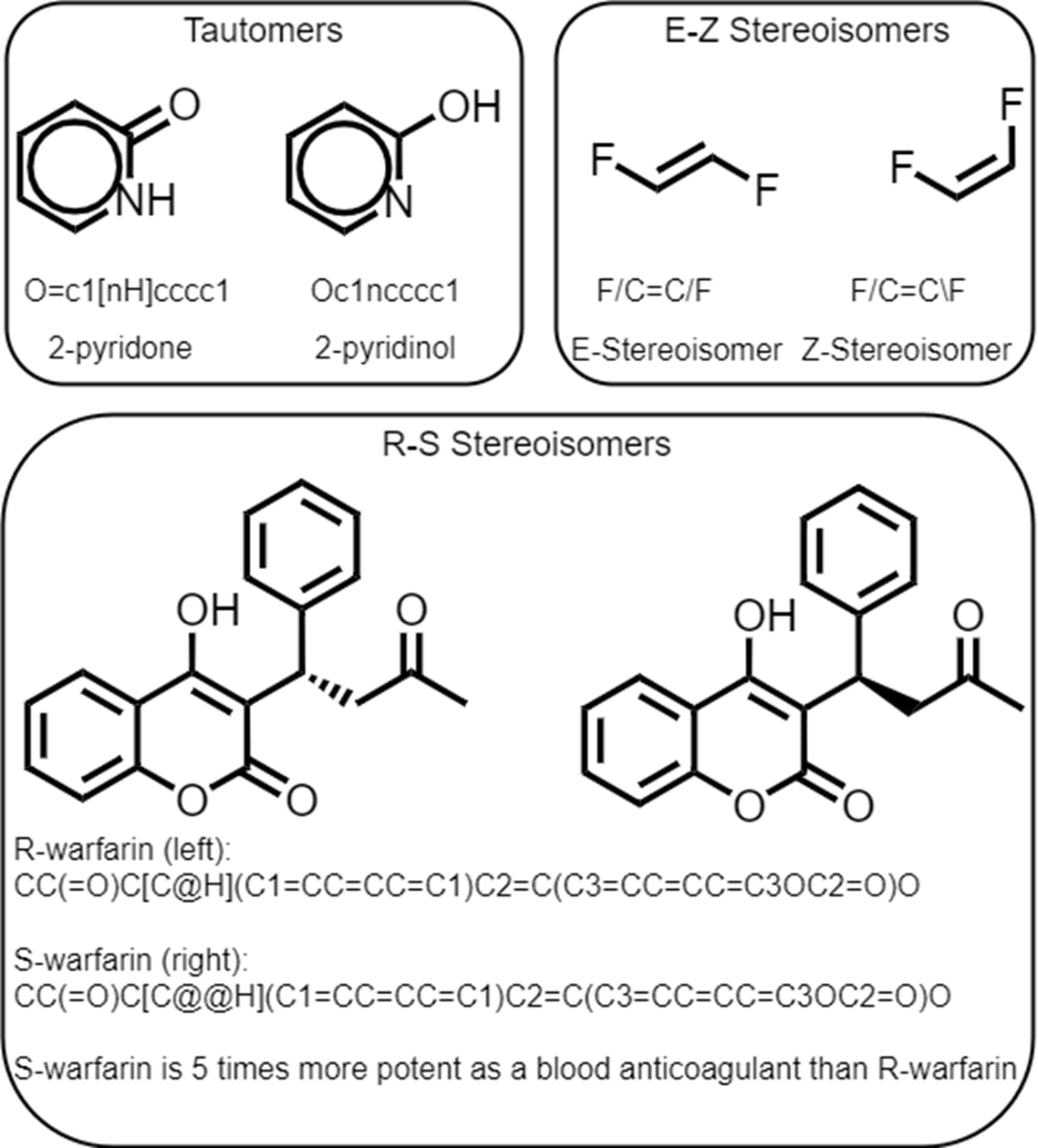
Compare paired SMILES representations that encode isomeric differences. section 1.2.1

How Build AI Drug Discovery Pipelines covers it

How deep it goes
Explains constitutional, tautomeric, and stereoisomeric differences, but stops short of detailed stereochemical encoding.
Examples
Uses butane and isobutane, tautomeric forms, and paired isomeric SMILES examples.
What you can do after
Evaluate molecular strings by distinguishing connectivity changes from spatial-orientation changes.
How it connects
Connects isomers with SMILES, stereochemistry, tautomers, stereocenters, and chirality.

This explainer was generated by Manning's knowledge graph from the text of Build AI Drug Discovery Pipelines. The section links point to the parts of the book it draws on.