Isomeric SMILES extend ordinary SMILES with explicit information about isomer-specific structure, including connectivity differences and three-dimensional stereochemistry. Isomers share a molecular formula but can differ in chemical properties. section 1.2.1
Distinguish the main kinds of isomeric variation:
- Constitutional isomers, such as butane and isobutane, share a formula but differ in atomic connectivity. section 1.2.1
- Tautomers interconvert through hydrogen movement and rearrangement of single and double bonds. section 1.2.1
- Stereoisomers retain the same formula and connectivity but differ in spatial arrangement; stereocenters and chirality describe important cases. section 1.2.1
Figure 1.3 Example pairs of isomeric SMILES.
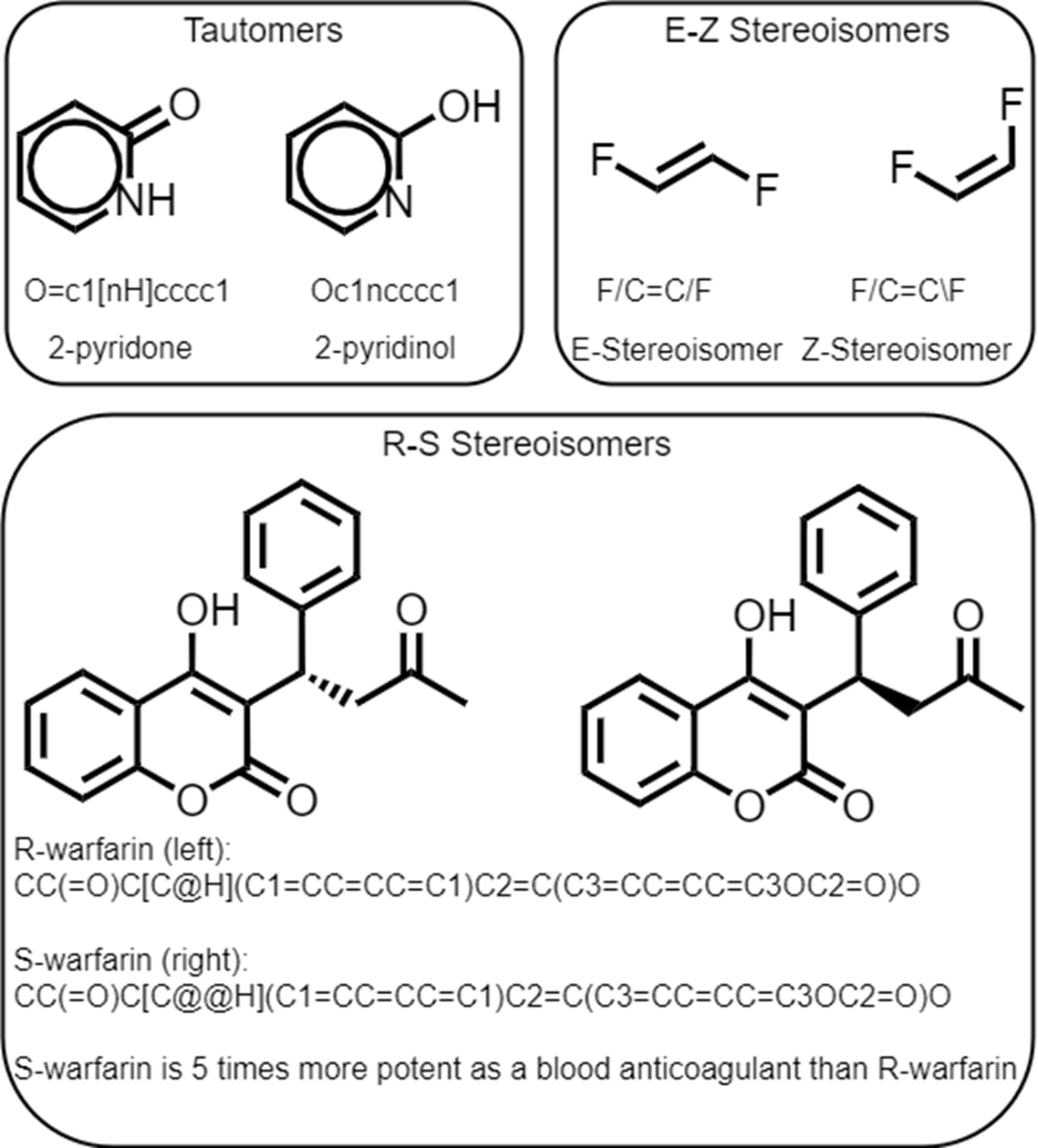
Compare paired isomeric SMILES representations to see how alternative structural or spatial arrangements are encoded. section 1.2.1
