liveBook · Manning

Iterative critique pattern

As explained in AI Agents in Action, Second Edition

An iterative critique pattern is a one-to-one hierarchical collaboration in which a critic evaluates and gates revisions of a worker's output.

An iterative critique pattern pairs one worker agent with one critic agent. The worker produces an output; the critic reviews it and gates whether it meets the goal. If it does not, the pair cycles through revision and review again. section 4.1.3

Unlike a debate, this is not a discussion among peers: the critic has authority over the worker’s output. Use the simplest coordination pattern that works, and add a critique loop when repeated review is worth the extra complexity. section 4.1.3

Figure 4.4 Various ways agents may coordinate execution sequentially or in parallel
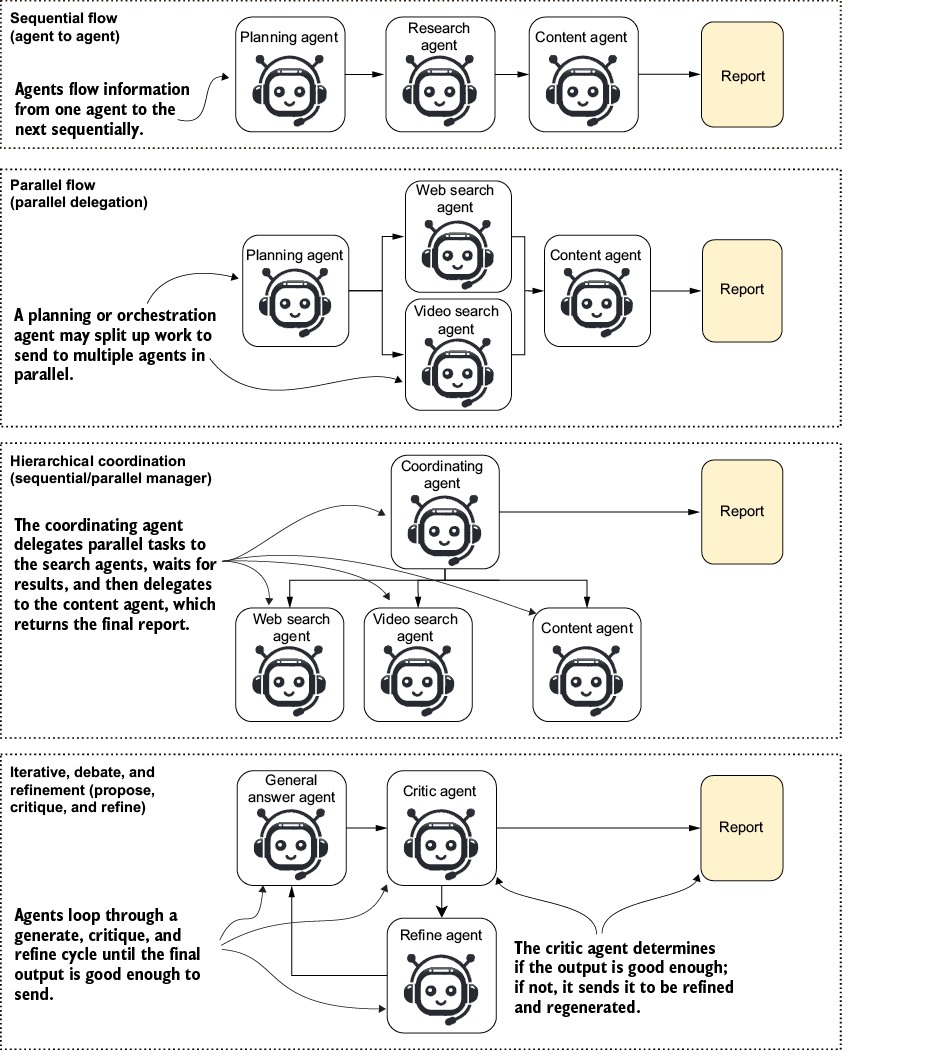
Compare the critique loop with sequential, parallel, and hierarchical ways to coordinate agents. section 4.1.3

How AI Agents in Action, Second Edition covers it

How deep it goes
Defines the roles and stopping condition but gives no implementation steps or code.
Examples
Illustrates the loop in a coordination-pattern figure, without a worked task.
What you can do after
Evaluate/understand when repeated review warrants a critic loop rather than simpler execution.
How it connects
Contrasts critique with peer debate and places it alongside sequential, parallel, and hierarchical coordination.

Related concepts

This explainer was generated by Manning's knowledge graph from the text of AI Agents in Action, Second Edition. The section links point to the parts of the book it draws on.