A jamming signal is deliberately transmitted after an Ethernet collision to notify other devices and disrupt frames that are being sent. It belongs to the CSMA/CD process used by half-duplex interfaces, especially on shared hub media. section 8.1.3
The collision response follows this sequence:
- Devices listen until the shared medium appears idle, then transmit. section 8.1.3
- Devices detecting a collision send a jamming signal, causing the in-progress frames to be discarded. section 8.1.3 section 8.3.2
- Each device waits a random period before attempting transmission again. section 8.1.3
Figure 8.2 Four PCs are connected to a hub, and two attempt to transmit at the same time, resulting in collisions. All four PCs are in the same collision domain. (1) PC2 sends a frame addressed to PC1’s MAC address, and PC4 sends a frame addressed to PC3’s MAC address. (2) The hub attempts to flood both frames at the same time, resulting in collisions. Neither PC1 nor PC3 receive their respective frames intact.
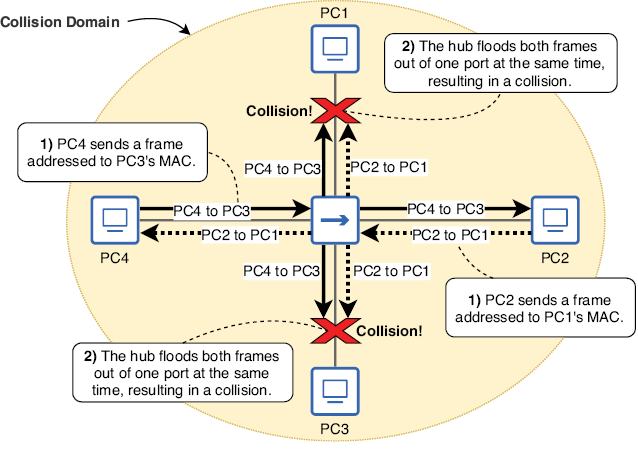
A hub scenario shows how simultaneous transmissions share one collision domain and why neither resulting frame arrives intact. section 8.1.3
A duplex mismatch can create apparent collisions: a half-duplex interface sends a jamming signal when a full-duplex peer transmits simultaneously. This may produce increasing collisions, late collisions, Runts, or CRC counters even without a physical collision. section 8.3.2
