JavaScript
JavaScript is a high-level, dynamically typed programming language standardized as ECMAScript and used for web and general-purpose programming.
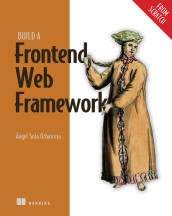
Build a Frontend Web Framework (From Scratch)
JavaScript used without a frontend framework or other abstraction layer.
- How it is used
- Builds a browser to-do app without a framework to expose the work involved in keeping its view synchronized with state.
- How deep it goes
- Works through setup, rendering, event listeners, and add, remove, and edit functions; stops short of production-level completeness.
- Examples
- Uses a to-do app with an input, Add button, dynamically created list items, and read and edit views.
- What you can do after
- Build it from scratch: implement a small interactive browser app and update its DOM explicitly after state changes.
Read how Build a Frontend Web Framework (From Scratch) explains JavaScript →
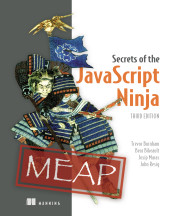
Secrets of the JavaScript Ninja, Third Edition
JavaScript is a high-level programming language standardized as ECMAScript and widely used for web and general-purpose software development.
- How it is used
- Powers interactive web pages and applications across browser, server, mobile, and desktop environments.
- How deep it goes
- Explains runtimes and surveys core semantics; defers detailed treatment of prototypes, closures, and asynchronous patterns.
- Examples
- Uses coercion expressions, a mistyped `setTimeout` call, and web-view versus native-component apps to expose behavior and tradeoffs.
- What you can do after
- Build it from scratch across supported runtimes while checking feature compatibility and using type checking to catch mismatches.
Read how Secrets of the JavaScript Ninja, Third Edition explains JavaScript →
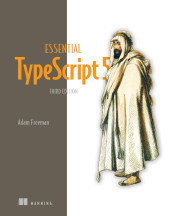
Essential TypeScript 5, Third Edition
A dynamic, multi-paradigm programming language standardized as ECMAScript and commonly executed in web browsers and server runtimes.
- How it is used
- Serves as TypeScript’s runtime output and package ecosystem while providing the type behavior that motivates static checking.
- How deep it goes
- Works through coercion and dynamic types, then explains compiler targets, module choices, and JavaScript type declarations.
- Examples
- Uses mixed-type prices, changing `typeof` results, a tax function, and ES5 compiler output.
- What you can do after
- Operate/configure it through TypeScript compiler targets and module settings, and diagnose unexpected results from JavaScript’s dynamic types.
Read how Essential TypeScript 5, Third Edition explains JavaScript →

Web Components in Action
JavaScript is a programming language standardized as ECMAScript and commonly executed in web browsers.
- How it is used
- Uses JavaScript to generate browser-component markup from data and support custom elements across browser environments.
- How deep it goes
- Explains template literals, interpolation, array-based generation, and transpilation workflows, but defers broader build-process details.
- Examples
- Demonstrates a customizable business card, generated select menus, ES2015 syntax, and separate modern-browser and IE11 builds.
- What you can do after
- Build data-driven Web Components and transpile their newer JavaScript syntax for IE11 with Babel.
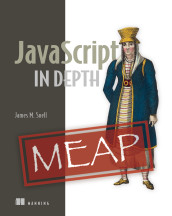
JavaScript in Depth
A high-level, dynamically typed programming language standardized as ECMAScript and commonly used for web development and other runtime environments.
- How it is used
- Diagnoses surprising asynchronous behavior, runtime differences, module effects, production bugs, and performance problems.
- How deep it goes
- Explains scheduling and runtime boundaries through runnable puzzles, but defers detailed treatment of types, promises, streams, garbage collection, and diagnostics.
- Examples
- Uses a hello-output puzzle across Node.js, Deno, Bun, Chrome, and Cloudflare Workers.
- What you can do after
- Diagnose/debug with runtime comparisons and execution-order reasoning instead of assuming source order determines output.
Bootstrapping Microservices, Second Edition: With Docker, Kubernetes, GitHub Actions, and Terraform
JavaScript is a high-level programming language standardized as ECMAScript and commonly used for web and server-side development.
- How it is used
- Uses JavaScript with Node.js to implement microservices, while treating the service language as a replaceable stack choice.
- How deep it goes
- Introduces the practical basics of a Node.js service and skims the platform rather than covering its full details.
- Examples
- Uses a video-streaming HTTP server as a first microservice and a local single-service development environment.
- What you can do after
- Apply JavaScript via Node.js and Express.js to create and run a basic microservice.
Pro Angular 16
JavaScript is a programming language commonly used to implement behavior in web pages and client-side applications.
- How it is used
- Positions JavaScript as the code browsers execute after an Angular application’s TypeScript and templates are compiled.
- How deep it goes
- Introduces basic language features and the compilation path, but stops short of a comprehensive JavaScript guide.
- Examples
- Traces `ng serve` through compilation and import-driven bundling, with a table identifying the resulting JavaScript bundles.
- What you can do after
- Evaluate/understand why Angular source files differ from the JavaScript delivered to a browser.
Math for Web Design
A standardized programming language commonly used to add computation and interactive behavior to web pages and applications.
- How it is used
- Calculates and updates frontend values when interactions, runtime data, or complex conditions exceed CSS math.
- How deep it goes
- Explains operators, Math methods, and increment order through examples rather than treating JavaScript as a whole language.
- Examples
- Uses a viewport breakpoint, increment assignments, and weighted dashboard widgets to make calculations concrete.
- What you can do after
- Apply it via JavaScript to calculate dynamic layout values and choose when CSS alone is sufficient.
Vanilla Web
A programming language standardized as ECMAScript and widely used to implement behavior in web browsers.
- How it is used
- Uses JavaScript to coordinate browser application state and data flow and add dynamic behavior to HTML and CSS.
- How deep it goes
- Defines Vanilla JavaScript and explains proposal stages, while previewing rather than working through modules, syntax, and error handling.
- Examples
- Uses a TC39 stage table and a comparison between transpiled framework code and directly shipped vanilla code.
- What you can do after
- Evaluate/understand it by checking browser support for proposed features rather than relying on ECMAScript edition labels.
Build a Website with ChatGPT
JavaScript is a programming language commonly executed in web browsers to provide interactive web-page behavior.
- How it is used
- Adds browser interactivity and dynamic behavior to frontend pages built with HTML and CSS.
- How deep it goes
- Defines event handlers and demonstrates generated implementations, but stops short of teaching JavaScript syntax or internals.
- Examples
- Demonstrates lightboxes, thumbnail click handlers, JSON-driven course catalogs, dropdowns, sorting, filtering, and search.
- What you can do after
- Apply it via generated code to build interactive static pages and customize them cautiously.
Acing the Frontend Interview
JavaScript is a programming language commonly executed in web browsers and other runtimes to add behavior and interactivity to applications.
- How it is used
- Prepares developers to explain language behavior and solve web-framework interview problems involving applications, APIs, performance, and maintainability.
- How deep it goes
- Explains scope, functional patterns, asynchronous internals, memory, and modules, while deferring detailed language syntax and full concurrency implementation.
- Examples
- Uses event delegation on an HTML list, parent-level click handling, bubbling, and asynchronous event-loop checklists.
- What you can do after
- Evaluate and explain JavaScript interview problems involving scope, functional code, asynchronous flows, event handling, memory, and TypeScript trade-offs.
Secrets of the JavaScript Ninja, Second Edition
A high-level, dynamically typed programming language standardized as ECMAScript and commonly used for web, server-side, desktop, mobile, and other application development.
- How it is used
- Supports application development across web, mobile, desktop, and cloud-based serverless domains.
- How deep it goes
- Introduces first-class functions, closures, scopes, and prototypes, while deferring detailed treatment of functions and scopes.
- Examples
- Contrasts Bob’s multi-language career with Ann’s JavaScript web, mobile, desktop, and serverless projects.
- What you can do after
- Understand core JavaScript mechanics and browser infrastructure for developing applications across domains.
Read how Secrets of the JavaScript Ninja, Second Edition explains JavaScript →
Software Engineering for Data Scientists
JavaScript is a programming language commonly executed in web browsers to add dynamic behavior to webpages.
- How it is used
- Adds interactive tables, form responses, button handling, and downloadable results to Flask web applications.
- How deep it goes
- Demonstrates focused snippets for libraries, event listeners, JSON data, and downloads without developing broader JavaScript expertise.
- Examples
- Uses a customer-churn table and a machine-learning prediction download link as concrete application examples.
- What you can do after
- Apply it via HTML templates and DataTables to render interactive data views and handle browser-side prediction downloads.
Read how Software Engineering for Data Scientists explains JavaScript →

Grokking Simplicity
A high-level programming language commonly used for scripting and application development across web and server environments.
- How it is used
- Uses JavaScript to teach language-agnostic functional-programming reasoning and asynchronous timeline analysis.
- How deep it goes
- Explains JavaScript’s single-threaded asynchronous model through callbacks, timelines, simplification rules, and a practical diagramming exercise.
- Examples
- Uses a dinner function, a button click handler, timeline diagrams, and a synchronous-action consolidation exercise.
- What you can do after
- Diagnose asynchronous ordering problems by drawing, simplifying, and interpreting JavaScript timelines.
D3.js in Action, Third Edition
A high-level programming language standardized as ECMAScript and commonly executed in web browsers and JavaScript runtimes.
- How it is used
- Supports D3 projects through method chaining, DOM manipulation, and dataset operations.
- How deep it goes
- Explains method chaining and object manipulation with examples, while deferring a full JavaScript introduction.
- Examples
- Uses chained D3 selections, arrays of values, employee objects, and map, filter, find, and forEach operations.
- What you can do after
- Apply JavaScript through D3 method chains and common array and object operations.
Read how D3.js in Action, Third Edition explains JavaScript →
Everyday Data Visualization
JavaScript is a general-purpose programming language widely used for interactive behavior in web browsers and other environments.
- How it is used
- Supports front-end web development and browser-based data visualization through libraries such as D3.
- How deep it goes
- Introduces asynchronous execution and D3-based visualization, but stops short of teaching coding fundamentals.
- Examples
- Uses a fruit-data bar chart and points to data visualizations published by The New York Times.
- What you can do after
- Apply it via D3 to create a basic web-based bar chart.
Road to Kubernetes
JavaScript is a dynamic programming language standardized as ECMAScript and commonly used for web application development.
- How it is used
- Uses JavaScript and Node.js to build a continuously reusable web application for learning deployment practices.
- How deep it goes
- Explains basic Express.js applications, dependencies, request handling, templates, and Git, stopping short of comprehensive application development.
- Examples
- Uses a basic Express.js web application, URL functions, HTTP methods, templates, package.json, and a Git repository.
- What you can do after
- Build it from scratch with Node.js and Express.js, track changes with Git, and prepare dependencies for repeatable deployment.
Architecting Accessibility
JavaScript is a programming language standardized as ECMAScript and commonly used to add behavior and interaction to web pages and applications.
- How it is used
- Uses JavaScript to help retrofit accessibility to custom, non-semantic elements when necessary.
- How deep it goes
- Mentions JavaScript's accessibility role but does not detail implementation.
Also covered in
- HTML5 in Action
- React Quickly, Second Edition
- The Well-Grounded Python Developer: How the pros use Python and Flask
- Get Programming with JavaScript Next: New features of ECMAScript 2015, 2016, and beyond
- Build AI-Enhanced Web Apps
- The Joy of JavaScript
- Building User-Friendly DSLs
- Go in Practice, Second Edition
- Lead Developer Career Guide
- Grokking Web Application Security
- Refactoring to Rust
- Pro ASP.NET Core 7, Tenth Edition
What to know first
- HTMLHTML is the standard markup language for structuring content and elements in documents on the web.
- CSSCSS (Cascading Style Sheets) is a stylesheet language for specifying the presentation and layout of structured documents.
- web applicationA web application is software that provides functionality through web technologies and is accessed over a network, typically through a browser or other web client.
- TypeScriptTypeScript is a statically typed superset of JavaScript that adds type-system features and is compiled to JavaScript.
Related concepts
- TypeScriptincludes · TypeScript is a statically typed superset of JavaScript that adds type-system features and is compiled to JavaScript.
- TypeScript compilerproduced by · The TypeScript compiler analyzes and checks TypeScript source code and can emit JavaScript and declaration files.
- ECMAScript language specificationequivalent to · The ECMAScript language specification is the formal standard defining the syntax, semantics, and built-in behavior of the ECMAScript programming language.
- D3.jsused by · D3.js is an open-source JavaScript library for binding data to documents and creating dynamic, interactive visualizations in web browsers.
- JSXincludes · JSX is a JavaScript syntax extension for expressing user-interface elements with XML-like or HTML-like markup that is transformed into JavaScript.
Questions about JavaScript
What is JavaScript?
JavaScript is a high-level, dynamically typed programming language standardized as ECMAScript and used for web and general-purpose programming.
Which Manning books explain JavaScript?
Build a Frontend Web Framework (From Scratch), Secrets of the JavaScript Ninja, Third Edition, Essential TypeScript 5, Third Edition, Web Components in Action, JavaScript in Depth, Bootstrapping Microservices, Second Edition: With Docker, Kubernetes, GitHub Actions, and Terraform, Pro Angular 16, Math for Web Design and 10 more.
What should I know before learning JavaScript?
Manning books that teach JavaScript usually introduce HTML, CSS, web application and TypeScript first.
What kinds of JavaScript are there?
Kinds of JavaScript include TypeScript and JSX.
What is JavaScript also called?
JavaScript is also called JS, ECMAScript or Java Script.
These guides are generated from the text of Manning books by Manning's knowledge graph and link to the sections they draw on. The full books are available on liveBook and at manning.com.