Suppose a warehouse service must find the closest hub to a location on a map. Scanning every warehouse for every request is costly. A k-d tree indexes points so that nearest-neighbor and region queries can skip parts of the search space. section 10.1 section 8.3
A k-d tree is a binary search tree of k-coordinate points. At depth i, a node compares coordinate i mod k. Its point acts as a pivot: points on one side of the resulting split go left, and points on the other side go right. In two dimensions, splits alternate between x and y, partitioning the plane into progressively smaller regions. section 9.2.1 section 9.2
Figure 9.8 An example k-d tree for a 2-D dataset. On the left, the tree representation. On the right, a visualization of (a portion of) the 2-D Cartesian plane, where the origin is at the center of the square. The vertical lines pass through nodes A, D, and E and correspond to splits along the x coordinate. The horizontal lines are drawn through nodes B, C, and F, and correspond to splits along the y coordinate.
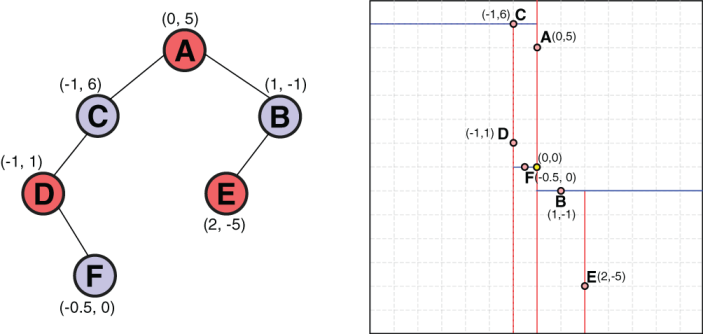
Compare each node’s position in the tree with its vertical or horizontal split in the plane. section 9.3
The split rule drives the main operations:
- For exact search, check the whole point for equality, then use the current split coordinate to choose a child. Insertion follows the same path and adds a node at an empty child; the shown implementation ignores duplicate points. section 9.3.1 section 9.3.2
- For nearest-neighbor search, visit the target’s side first while tracking the best distance. Backtrack into the opposite side when its split plane is closer than the best candidate; otherwise prune that branch. Several nearest neighbors can be tracked with a bounded priority queue. section 9.3.5
- Deletion requires more care than ordinary BST deletion: promoting a child changes its split level, while a replacement minimum for a chosen coordinate may lie deep in a subtree. section 9.3.4
Shape matters. An unfortunate insertion order can produce linear height; a balanced tree gives logarithmic-height search and insertion. If the points are known in advance, recursively select a median on the current split coordinate and build the two subtrees. This construction takes O(n log n) time and O(n) memory. Later updates do not automatically preserve balance. section 9.2.2 section 9.3.3
For a balanced tree, exact search and insertion take O(log n) time. Nearest-neighbor search can still inspect every point in an adverse case, although pruning helps in practice. Its advantage weakens as dimension grows; frequent updates, poor memory locality, and non-point objects are further reasons to consider another index. section 9.3.7 section 9.4
Assigning points to centroids
In k-means, build a k-d tree over the current centroids and query it for each point’s nearest centroid. Rebuild the tree each iteration because the centroids change. This trades construction work for faster classification when there are enough centroids; tests with very few centroids favored brute force. section 12.2.4


