liveBook · Manning

Kafka appender

As explained in Kafka for Architects

A Kafka appender is a logging component that publishes log records to Kafka.

A Kafka appender is a logging component that sends records from an existing logging framework to Kafka. The application continues using ordinary logging calls, while external configuration determines the Kafka destination. section 5.1.3

Architecturally, the appender provides:

  • Separation between application logging code and Kafka producer interaction. section 5.1.3
  • Configuration changes without modifying application code. section 5.1.3
  • A route for centralized log processing, such as Kafka to Elasticsearch. section 5.1.3

Authentication service logging

A microservice can either call a Kafka producer directly for login events or log through a framework such as log4j, logback, or SLF4J. A Kafka appender favors the latter when Kafka routing should remain outside application code. section 5.1.3

Figure 5.7 Sending log data via Kafka to Elasticsearch
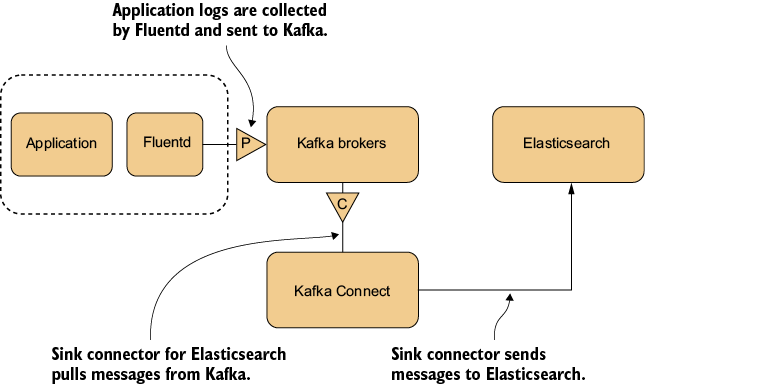
Use the pipeline view to trace log data from collection through Kafka to Elasticsearch. section 5.1.3

How Kafka for Architects covers it

How deep it goes
Defines the integration pattern and its trade-off, but does not detail appender configuration or producer internals.
Examples
Uses authentication login events and a Fluentd-to-Kafka-to-Elasticsearch log pipeline.
What it assumes
Assumes familiarity with application logging frameworks and Kafka producers while illustrating framework-based integration.
What you can do after
Operate centralized log delivery by routing framework-generated records through externally configured Kafka appenders.
How it connects
Connects logging frameworks with Kafka producers, Fluentd, Kafka Connect, Elasticsearch, and centralized logging.

This explainer was generated by Manning's knowledge graph from the text of Kafka for Architects. The section links point to the parts of the book it draws on.