A Kafka broker is a Kafka server that stores, receives, and serves records for producers and consumers. It treats each record as opaque bytes, forwarding application-level interpretation to clients. section 1.5.1 section 4.2
A production deployment normally uses a cluster of brokers. Brokers handle client traffic, storage, and replication, while KRaft controllers maintain metadata, coordinate cluster operations, and detect failed brokers. section 1.3.2
Consumer polling
A consumer requests partition assignments, polls a broker repeatedly, receives available records in batches, deserializes and processes them, then commits its offset. The offset records where reading resumes; it does not confirm successful processing of each record. section 4.2
Broker opacity keeps Kafka fast and flexible but prevents broker-side content-based routing and message validation. Clients must deserialize and validate records, or an intermediate service such as Kafka Streams or Apache Flink must route them. section 5.2.3 section 1.5.1
Figure 1.4 Structure of a Kafka cluster: brokers handle client traffic; KRaft controllers manage metadata and coordination.
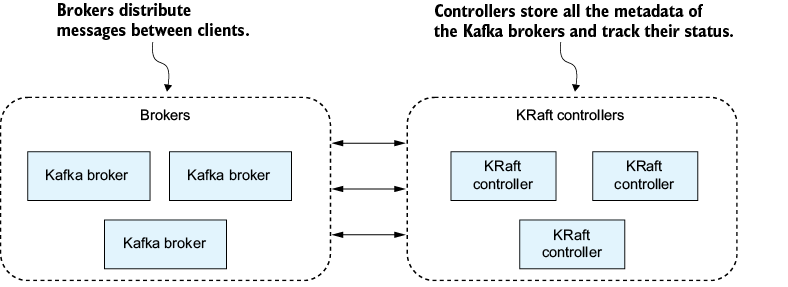
Use the cluster view to distinguish broker responsibilities from KRaft controller responsibilities. section 1.3.2


