Kafka’s binary protocol carries requests and responses between clients and brokers over TCP/IP. Client libraries hide serialization, transmission, acknowledgments, retries, and protocol-version negotiation while preserving common architectural principles across languages. section 3.1.1
The protocol supports an architecture in which:
- Producers serialize records, select partitions, assemble batches, send them to brokers, and optionally wait for acknowledgments before retrying failed or unacknowledged batches. section 3.1.1
- Clients and brokers negotiate the highest mutually supported API version, allowing independent upgrades when compatible versions exist. section 3.1.1
- High-level frameworks simplify integration, while low-level clients expose control over message conversion, dead-letter routing, concurrency, and offset handling. section 3.1
Customer 360 integration
A customer-profile service validates and publishes profile changes to Kafka, while another service consumes profile, billing, and interaction topics to build a consolidated profile. Both applications embed producer or consumer logic, commonly through a framework or client library. section 3.1
Protocol interoperability and browser limits
Azure Event Hubs accepts existing Kafka clients through the Kafka protocol, whereas browsers cannot connect directly because they lack raw TCP access; browser integrations therefore require an HTTP-based REST Proxy or another supported bridge. section 5.3.3 section 12.2.1
Figure 3.1 Simplified workflow of message transmission by a producer, including serialization, partition selection, batch assembly, and data transmission to the server, with an optional confirmation step
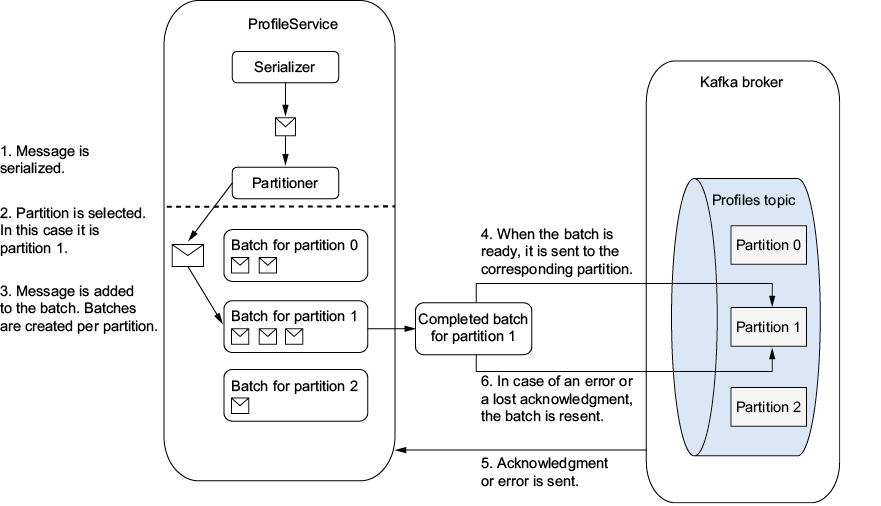
Trace the producer path from serialization and partition selection through batching, transmission, and optional broker confirmation. section 3.1.1
